Fireside Trance drives Selection for Enhanced Attention & Working Memory via Baldwin Effect

Fireside hypnotizability

Following up on a previous post tracking down the original sources for the December Smithsonian piece about hearth fires & cognitive evolution, evolutionary psychologist Matt Rossano’s “Did Meditating Make Us Human?” spins out a model similar to & building on McClenon’s ritual healing hypothesis.  Basically, he integrates Klein’s suggestion that a genetic mutation precipitated the Upper Paleolithic human revolution.  I know, I know, the revolution that wasn’t, since data now suggest that there was a slow evolution of human cultural capabilities that culminated in a glut of evidence for human symbolic expression at the Upper Paleolithic in Europe.

Matt Rossano

Matt Rossano

But wait, why didn’t we have a slow accumulation over a longer period of time?  We have evidence of human symbolic creativity much earlier in Africa but why the sudden, rapid, & more extensive appearance in Europe?  Could we have both a slow evolution followed by a rapid revolution?  Rossano suggests we could have.  He portrays the scenario as follows:

  1. Convincing evidence of symbolic expression does not appear until after 50,000 bp.
  2. This symbolic expression appeared late in human evolution as the result of a genetic mutation that enhanced working memory.
  3. This mutation may be the result of a Baldwin effect, which is a heritable mutation that follows functional change instead of the other way around.
  4. The functional change may have been the increased experience of fireside trance that resulted from continual fire use/ritual, as neuroscience indicates that meditative states influence the areas of the brain devoted to working memory.
  5. Thus, hypnotizability may have been fitness-enhancing in our evolutionary past.

Campfire rituals disporportionally enhanced the health of those whose brains permitted the deepest immersion in the rituals; and this, in turn, selected for brains with enhanced working memory capacity (Rossano 2007:48).

Symbolic Thinking

Rossano makes a good point, citing Charles Peirce, with regard to symbolic thinking.  Referential thinking comes in three forms, according to Peirce–iconic, indexical, & symbolic.  Iconic things look like what they describe (e.g., circle to stand for a ball), & indices indicate (go figure) the spatial or temporal presence (e.g., a puddle indicates recent rain).  Peirce reserves the term “symbolic” for relationships that are arbitrary (e.g., & for and).

It is this “higher-level” Peircian symbolism that arrived later in human evolution.  So, while we see evidence for communicative culture, we don’t see the emergence of symbolic until the period of the human revolution & the Middle Paleolithic.  This emergence relied on enhanced working memory, according to Rossano’s model.

Baldwin Effect

James Mark Baldwin was an American psychologist & philosopher of the late 19th century who made significant contributions to development psychology & evolutionary theory, among other things.  His non-Lamarckian explanation for how environmental conditions could drive heritable change is a predecessor to contemporary epigenetic theory.

James Mark Baldwin was an American psychologist & philosopher of the late 19th century who made significant contributions to development psychology & evolutionary theory, among other things. His non-Lamarckian explanation for how environmental conditions could drive heritable change is a predecessor to contemporary epigenetic theory.

The Baldwin effect is a principle of evo-devo that was outlined over 100 years ago as a non-Lamarckian way for environmental pressures to drive heritable change.  It was displaced by the modern synthesis but has re-emerged in the wake of Waddington’s conceptualization of canalisation & the epigenetic landscape.  For instance, who found that by exposing pupal fruit flies to heat stress, he could produce a developmental change that would be inherited by subsequent generations in the absence of the stress.  Similar mechanisms have been demonstrated in other animals, including mammals.

Rossano suggests that environmental changes pushing humans to adapt in unique ways could have driven a Baldwin-like effect in our ancestors.  There is a bit of tautology here, as he doesn’t propose what that environmental change was.  He merely says that human brains got suddenly bigger after not having been big for a long time, thus, Baldwin effect.  Actually, he is insinuating, I think, that the environmental change is the use of fire.  But he doesn’t explain how fire has been used by hominids since erectines but is not driving the Baldwin effect until much later.  Why the ramped up use of fire?

He & Gowlett don’t cite each other in the articles I’ve read so far, but perhaps they could help each other out on this point.

Meditation

There has been a slough of meditation research over the past several decades that have demonstrated affects on the brain.  I spent a fair amount of time reviewing the literature as a grad student, so I am an easy sell on this point, but Rossano’s conclusions suggest more than simply, ‘meditating is good for reducing stress & thus is healthy.’  He says, more profoundly, that

meditation produces long-term changes in those areas of the brain involved in attention and working memory.  These areas are critical for the enhancement of working memory capacity.  This enhancement may have given Homo sapiens a competitive edge over other hominins and produced the emergence of symbolism about 50,000 bp.  However, it can rightly be pointed out that it seems quite unlikely that our ancestors of 100,000 years ago or more were engaging in one-point or compassionate meditation.  While true, numerous other studies have shown that far more mundane memory and attention tasks also activate the same brain areas.

He points out that relatively simple neuroscience tasks produce effect improved memory & speculates that shamanic campfire rituals probably included more complicated tasks & would be have a greater affect on memory, including those of children who were doubtless present (& thus provide the circumstances for a Baldwin effect).

Hmm…

As much as I study this topic & find myself compelled by these models, when we get to the juncture of the shamanic campfire ritual, I find that I am rolling my eyes at what seems New Age-y mumbo jumbo.  I find the Baldwin effect driving a mutation related to working memory & attention compelling, as it provides a better mechanism that Wrangham & McClenon’s fireside-trance-made-people-nicer-&-thus-fitter model, but the shamanic model of human evolution still sounds hokey.  But I don’t have a better explanation for the evidence, & until it occurs to me or something better comes along…

Share
Posted in Adaptation, Biological Anthropology, Cultural Evolution, Hypotheses | Tagged , , | 2 Comments

More on “Angst,” a New Book on Evolutionary Psychopathology

A couple months ago, I mentioned a new book of interest to those who like clinical psychology and evolution. It’s called Angst: Origins of Anxiety and Depression by Jeffrey P. Kahn, M.D., a psychiatrist at Weill Cornell Medical College who also has a private practice in New York.

I’ve finally had the time to read it, and what follows is not a review, really, but just a bit of info about the book so you can decide if it’s of interest to you.

To begin with, Angst seems to have been written largely with a lay audience in mind. Thus, each chapter begins with a little gag cartoon and a couple of quotes. Furthermore, Kahn’s style is immediately accessible, casual, even loose, in a fun sort of way. The book is largely free of technical jargon; instead, Kahn peppers the chapters with lyrics from blues and rock songs, as illustrations of the various forms of angst he discusses. Are they necessary for his points? Of course not, but if you grew up listening to classic rock radio as I did, you’ll dig the references.

Kahn’s basic premise is that our modern experiences of angst are the result of evolved social instincts that originally arose to keep our ancestral “herds” together. Kahn posits six of these social instincts, five of which are involved in specific corresponding disorders. They are: 1) panic anxiety; 2) social anxiety; 3) obsessive-compulsive disorder; 4) atypical depression; 5) melancholic depression; and 6) consciousness. I shall henceforth capitalize each of these, as Kahn does, to emphasize their status as proper types within this scheme.

Kahn views most of the anxiety disorders he mentions as adaptations. If one takes an adaptationist perspective on a particular mental disorder, one can think of that disorder as either an adaptation in its own right (i.e., it does exactly what it was evolved to do, what I call the strong adaptationist sense); OR, as a disinhibition, over-expression, or perseveration of processes which evolved as adaptations but which should be considered disordered rather than adaptive in their overactive forms (I call this a weak adaptationist perspective). My view is that Kahn generally leans toward the “strong” end of the spectrum in some regards (essentially stating that each disorder is evolved for a particular purpose), although he does certainly acknowledge that modern-day circumstances make for undesirable effects of these evolved angst instincts (this is, in fact, the theme of the book).

The mechanisms behind Panic Anxiety, according to Kahn, evolved to keep us from straying too far from our social groups. Thus, being isolated from the comfort of our home, friends, and family can bring on panic, as can personal success which may threaten to alienate those close to us. Social Anxiety, says Kahn, is involved in maintaining social hierarchies, keeping us from stepping unduly out of line or challenging our superiors.

Obsessive-Compulsive Disorder is seen as a set of mechanisms which promote fitness by engaging in scrupulous behaviors such as “cleaning, arranging, saving, and behaving” (I have written about this perspective on OCD before, and it was a basis for my master’s thesis). Essentially, OCD-like thoughts and behaviors tend to fall into one of a number of apparently fitness-relevant domains such as resource-acquisition (as in hoarding) or cleaning (as in contamination obsessions and washing compulsions).

In one of the more interesting moves (to me, anyway, since I don’t closely follow this line of research), Kahn separates two of the major depression subtypes into two different evolved instinct domains, with two distinct functions. Atypical Depression (in which people sleep too much, eat too much, and gain weight) is a mechanism involved in maintenance of social relationships and avoidance of social rejection.

Despite the name, atypical depression is more common than the so-called “classical” form, known as Melancholic Depression (wherein people have trouble sleeping, lose their appetite, lose weight, lose interest in pleasurable activities, and seem to act and think in slow motion). Kahn sees melancholic symptoms as related to a “death instinct,” in which individuals lose the will to live and either elicit help from group members or cash in their chips entirely, so the group does not waste further resources on them. This hypothesis might appear to rely on the controversial group selection theory, but it could just as easily be viewed through a kin selection lens.

The final of Kahn’s social instincts — or rather, process which controls our instincts — is Consciousness. Psychoticism and mania are viewed as breakdowns in this instinct (as opposed to the other five social instincts in which the associated disorders are essentially exaggerated displays of the instinct).

The question of why some people’s social instincts develop into disorders while other people’s do not isn’t exhaustively explored, but Kahn does imply that the tendency for each group of traits is on a continuum, and some folks may be naturally higher on these continua than others; combined with situational stressors, disorder may result in those individuals. In fact, Kahn goes a step further and ties each social instinct to one of the Big Five personality traits: Consciousness with Openness, Obsessive-Compulsiveness (the “nesting instinct”) with Conscientiousness, Social Anxiety (the “hierarchy instinct”) with Extraversion, Atypical Depression (the “social harmony instinct”) with Agreeableness, and Panic Anxiety (the “separation instinct”) with Neuroticism. Melancholia (the “death instinct”) is not associated with one of the Five-Factor traits, although Kahn suggests that such a trait may exist — it just hasn’t been uncovered in the Big Five model because it’s not a trait that normal individuals generally experience.

Using this scheme, Kahn goes on to describe why our modern environment has quite high levels of this so-called “angst.” He appeals, among other things, to mismatch theory – the suggestion that our modern environment contains novel types, intensities, and frequencies of particular stimuli that would have been as likely in most of the millions of years during which our central nervous system evolved.

What treatment implications do evolutionary perspectives have on clinical psychology? This is a big question, and theoretically, the possible answers range from “Absolutely none” to “We shouldn’t treat so-called ‘disorders’ at all.” In reality, most opinions are more moderate, and Kahn, for one, believes that psychopharmaceutical treatment along with psychotherapy is still the best treatment method for most disorders. His theoretical case studies in each chapter often mention therapies which are mildly evolutionarily-informed, although he does not generally give specific recommendations, as this would be beyond the scope of the book. Kahn also emphasizes the utility, and often the difficulty, with what he calls “counter-instinctual” behaviors; for example, rather than give into social anxiety and avoid all social situations, the patient in Kahn’s case study sought out socially challenging scenarios like student body president, salesperson, and presenting sales-trainer.

Since his intended readership is much wider than just clinicians and researchers, Kahn does not presume that you, the reader, know anything about the DSM classification schemes or any other definitions or typologies of mental disorder. In fact, if you are like me, having a moderate familiarity with DSM categories may initially confuse you as to attempt to reconcile your background knowledge into Kahn’s new theoretical scheme. For example, when beginning the chapter on Panic Anxiety, I was unsure which particular DSM conditions Kahn was subsuming under the term “Panic” — only panic disorder? Any panic attack? Generalized anxiety disorder? Phobias too? As each chapter progresses, these specifics become clearer, and there’s an appendix in the back of the book with standard diagnostic criteria which helps illuminate things.

Kahn does explain in the opening chapter that he chooses to focus on the five disorders he does because they are so common and seem to parsimoniously explain a number of other syndromes. He also says — a point I can certainly appreciate — that the DSM classification is not necessarily the most valid one from an evolutionary perspective, and thus, his implication is that the particular way the DSM carves up disorder is not relevant for understanding his current scheme. This much is true, although I wanted to know which particular DSM disorders Kahn was including under each of his five disorders. Those who are extremely well-versed in the DSM (I am not) will probably be able to figure this out fairly easily from the information Kahn gives.

So: while Angst necessarily draws on and synthesizes other clinical research and evolutionary psychopathology approaches, it is not an overview of the entire discipline of evolutionary clinical studies…rather it is a novel scheme for integrating evolutionary perspectives into medical health and illness. For practicing clinicians, the book may offer many valuable new insights and perspectives, but is not a manual of specific therapeutic recommendations. For researchers interested in general evolutionary clinical psychology, the book is a must-read, since it is the newest in a very small number of texts which blend evolutionary and clinical insights. For lay readers interested in one way in which evolution can inform clinical psychology, I would also strongly recommend Angst. It’s an easy read and a lot of fun.

Angst: Origins of Anxiety and Depression (2012) by Jeffrey P. Kahn is available on Amazon (in hardcover and Kindle versions), in major bookstores, and perhaps in your local library.

Share
Posted in Clinical Psychology, Evolution and Psychology, Evolutionary Medicine, Uncategorized | Leave a comment

Evolutionary Psychology for Kids – Part 1

Evolution and Human Behavior – Thoughts for 6th Graders

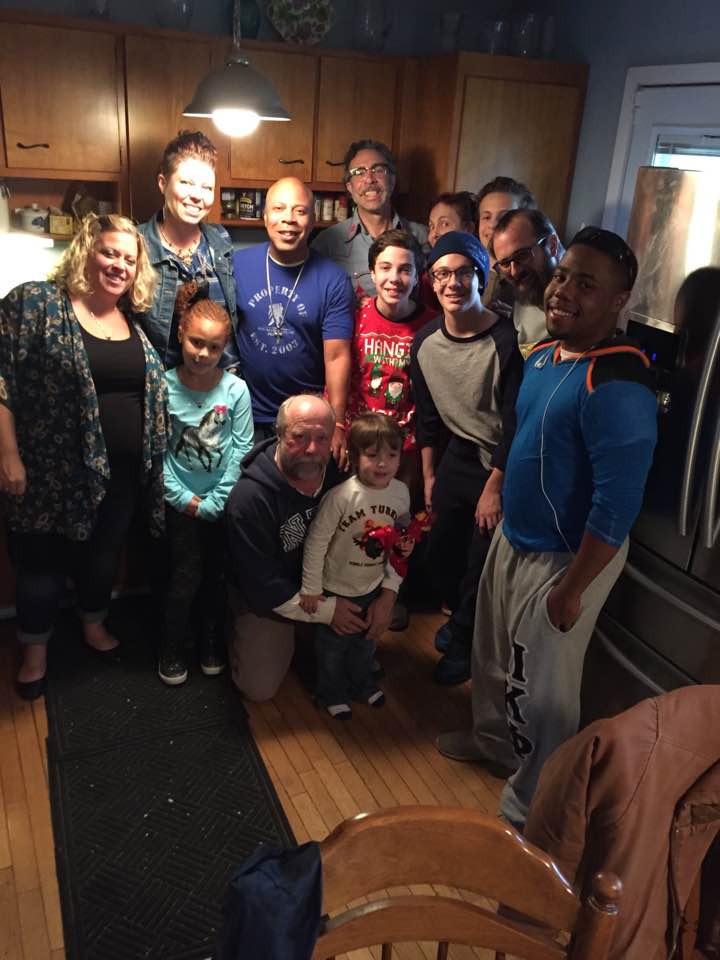
In late 2011, my daughter Megan, then 11, was taking an awesome social studies class in 6th grade. Her teacher, Ms. Naclerio, was very interested in evolution and human origins – so Megan chimed in and and was like “hey, my dad sort of studies that kind of stuff – maybe he can come in and talk about it with the class.” So the deal was done before I even got home that day!
Hmm – I’m an evolutionary psychologist – not a fossil guy who’s done fieldwork in the African Savanna. What ideas from my field could I talk about that would explicate some important ideas related to their curriculum on human origins?

As luck would have it, this all was right around the time that we were planning a visit to campus with the iconic Robb Wolf (author of The Paleo Solution), as part of SUNY New Paltz’s Evolutionary Studies (EvoS) Seminar Series. Robb’s work (encapsulated in Robb’s talk at New Paltz, found here) focuses largely on an idea that’s basic in evolutionary psychology – Evolutionary Mismatch – or the idea that problems emerge when an organism happens to exist in an environment currently that mismatches important features of the environment that was typical during the evolutionary history of that organism. According to Robb and others in the Paleo field, people in “advanced” societies like ours have many major health problems, such as obesity, because our modern environments (which include things like McDonald’s) have historically unprecedented amounts of unnatural, processed foods (milkshakes, high-fat meat, foods densely loaded with carbs, etc.).

Evolutionary Psychology (as addressed in my newest work; Geher & Kaufman, 2013) largely focuses on this idea of mismatch – our family structures mismatch ancestral structures (which included a higher proportion of kin who were local; see Hrdy, 2009), our educational structures mismatch ancestral educational “structures” (which were not really “structured” at all; see Gray, 2011), and so forth. I figured that this general idea, of evolutionary mismatch, would be accessible and provocative for the 6th graders to think about.

And I’ve got to say, I think it went really well. The kids seemed every bit as attentive as my awesome college students – and the questions are on-task and got me to think quite a bit – it was lots of fun! And I think it got kids thinking about how evolution may impact several aspects of everyday life. And, as luck would have it, Principal Wiesenthal and Assistant Principal Tantillo were in attendance – this made me happy!

Below is the outline of the presentation I gave, to give a sense of the content. This outline was put up on the board during my presentation and I gave copies to students as a handout as well.

Evolution and Human Behavior – A presentation by Glenn Geher given to 6th graders at New Paltz Middle School

12/5/2011

How can understanding human evolutionary origins help us understand how people think and behave?

  • “Modern humans possess a Stoneage mind in a modern world”
  • The Environment of Evolutionary Adaptedness (EEA) – ancestral conditions that characterized what the world was like when our ancestors were evolving into humans.
    • African Savanna
    • PRE-AGRICULTURE – for 99% of human evolutionary history, humans were nomads – following the food as opposed to growing it
    • Civilization and Cities DEPEND ON AGRICULTURE!
    • So there were no cities until about 10,000 years ago (after the advent of agriculture)
    • Bands of humans tended to be capped at about 150 (including many kin members)
    • Droughts were common – and with droughts came famine
    • Average human bands would walk up to 20 miles a day – regularly
    • IMPLICATIONS FOR MODERN HUMAN BEHAVIOR
      • FOOD – since famine was common, people evolved to like foods with high sugar and high fat – these food preferences helped people put on needed fat to make it through famine conditions
        • BUT POST-AGRICULTURE, these food preferences are actually unhealthy!
        • Further, these evolved food preferences explain why McDonald’s has sold billions and billions …
  • EXERCISE – our human ancestors were not overweight – partly due to famine conditions – and partly due to exercise. They didn’t need to pay $500 a month to join a gym – life was a gym – and the savanna was their treadmill!
  • EDUCATION – under ancestral conditions, there were no schools! People learned by observing and interacting with others in their band. And good evidence suggests that the main teachers of kids were kids who were slightly older than themselves – being outside, doing stuff that needed to be done, and interacting in a mixed-age environment was school for our ancestors. No report cards!
  • EVOLUTIONARY MISMATCH
    • When the modern conditions of an animal don’t match the animal’s EEA
    • Humans live in contexts that are, in some ways, very different from the EEA
    • This is partly why we have issues such as obesity in societies like ours
    • Making modern societies more like the EEA might be a key to improving human health.

 References

Geher, G., & Kaufman, S. B. (2013). Mating intelligence unleashed: The role of the mind in sex, dating, and love. New York: Oxford University Press.

Gray, P. (2011). The special value of age-mixed play. American Journal of Play, 3, 500-522.

Hrdy, S. B. (2009) Mothers and Others: The Evolutionary Origins of Mutual Understanding. Cambridge: Harvard University.

Wolff, R. (2010). The Paleo Solution. Las Vegas, NV. Victory Belt Publishing.


Share
Posted in Uncategorized | Leave a comment

Manning a perpetual fire was linked to language & social network development

The December 2012 issues of Smithsonian Magazine had a fire theme, & archaeologist Thomas Wynn contributed a short piece on the influence of fire in the evolution of the human mind.  He briefs the work of three researchers doing work I didn’t know about–John Gowlett, Frederick L. Coolidge, & Matt Rossano–including one (Rossano) whose book on the evolution of religion (Supernatural Selection) has actually been sitting on my shelf to review for a course for over a year.  I pulled some of their relevant articles & began reading, starting with Gowlett’s 2006 piece, “The early settlement of northern Europe: Fire history in the context of climate change and the social brain” in Comptes Rendes Palevol.

Dr. Gowlett is British archaeologist & one of the directors of the Archaeology of the Social Brain project. This paper considers two hypotheses to explain the distribution for fire manipulation by humans around 0.4 million years ago–(1) that inconsistent evidence for fire manipulation at sites from this time period are due problems of preservation & past climate change or (2) that changes in human social network size increased human abilities to exploit certain environments in tandem w/ & via increased language capacity & associated socio-technical skills like fire management (2006:300).  The issue revolves around the sudden appearance of concentrations of early fire evidence at sites around the Middle Pleistocene, 400kya, scattered throughout Europe, but there is a good chance that earlier evidence could have been eradicated through glacial processes.  Is this sudden but not uniform concentration evidence of the elaboration of socio-technical skills & the social brain or what wasn’t wiped clean? 

A model for the pattern fire use in hearths at Middle Pleistocene sites based on Beeches Pit (Fig. 5, Gowlett 2006)

A model for the pattern fire use in hearths at Middle Pleistocene sites based on Beeches Pit (Fig. 5, Gowlett 2006)

Beeches Pit in East Anglia, UK is an example of a Middle Pleistocene site that has yielded extensive evidence of hominid occupation, including abundant evidence of fire use, including burnt flints & what have been interpreted as hearths.  Multiple hearths are separated at two stratigraphic levels in a context near the edge of a body of water, suggesting the strategic placement with water on one side & dead-wood fuel on the other.  Large tails of burnt material suggests prolonged fires, which may because hominids had not yet mastered kindling fires & had to keep them going.  Modern evidence suggests that this is not due to forest fires, as they are rare, only return to the same areas every 10-300 years, & are even more rare along water courses.

 Although there is no evidence for controlled fire use of this type in Northern Europe prior to 500kya, there is evidence at Gesher Benot Ya’aqov in Israel ca. 700kya & possibly in Africa at Chesowana ca. 1.4mya.  This suggests that the lack of evidence in Northern Europe may be due to climatic conditions.  However, the social brain hypothesis places changes in brain size at 500-300kya, which would coincide with this appearance of controlled fire use in Northern Europe & be consistent with theories of enhanced network size & language evolution at this point.  The larger brains & larger network sizes would “impose larger ‘managing’ loads on the brain,” the costs of which would be met by higher grade diets & reduced guts, made possible thru cooking.

Although there is evidence of increased cranial size from Atapuerca & Ceprano associated with Homo, there is no corresponding model for “proto-fire-use.”  In other words, what was the spark (pun intended) that put these larger brained hominids onto fire use?  Gowlett’s tentative scenario is that

fire use became advantageous at an early date, for reasons of adaptation to climate, and extension of diet, but that perhaps early humans could control it only in particular circumstances.  This would expalin why so many early sites have no fire evidence… (2006:306)

Earlier fire use may have afforded benefits, but if kindling was not mastered, its use would be driven by climatic conditions.  In temperate conditions, the cost of letting the fire go out was low.  In cold conditions like that encountered in Northern Europe at the edges of the glacier areas, the cost would be high, perhaps stimulating a division of labor to tend the fire & bring fuel.  Thus, systematic fire use without knowledge of kindling would require strong social networks, issues that had been effectively resolved by 40kya.

Share
Posted in Anthropology, Archaeology | Tagged , , , , , | Leave a comment

“Anthropologists finally crack the interspecies linguistic barrier…


Bruce McCall (April 2012) "The Future that Wasn't, " Smithsonian.

Bruce McCall (April 2012) “The Future that Wasn’t, ” Smithsonian Magazine.

Share
Posted in Anthropology, Linguistics, Primates | Tagged , , | Leave a comment

Signaling Religious Commitment in Brazilian Candomble

I was critiqued in a recent NSF grant proposal review that, while I elegantly integrated signaling & cultural consensus theories in my research design, my statements that (1) signaling theory derives from evolutionary biology & (2) that no one has tested religious signaling in context are dead wrong & overly reliant on the Rich Sosis school of religious signaling.  Whoops, guilty as charged.  I did know that signaling theory derives equally from economics & a whole bunch of other fields & probably had it footnoted in some previous version that I cut to save space.  I learned signaling theory under Lee Cronk in the one brief month I studied at Rutgers before moving to a different graduate program & forgot about it more or less for 5 years until I was writing my dissertation & read Sosis’s “badges, bans, & behaviors” paper, which blew my mind.  Since I had just spent two years in Apostolic Pentecostal churches, I could envision everything he was talking about, & it transformed by consciousness about the field site.  It was all I could do to stay the course & get my dissertation written without reanalyzing everything from a signaling perspective.  Since then, I’ve had a little more time to catch up on this theory & have a paper out in Ethos that discusses an incident my one of my New York field sites from a signaling theory perspective.  But, honestly, I haven’t done much more to expand my knowledge of the theory than to read some Bulbulia, Cronk, Sosis & Alcorta, & one really awesome 2005 Bird-Bliege & Smith paper in Current Anthropology (I wish that reviewer had offered a little more direction in this regard, but I guess I will have to actually do my homework myself & Google it–whoops, did I say that out loud?).

However, what I actually consider shameful is that I wasn’t aware at the time of anyone having investigated religious signals of commitment in context, when in fact it has been done by another Cronk student, Montserrat Soler.  My friend Bria Dunham, another Cronk-trained signaling theorist, who was assigned as my student-mentor for that brief month at Rutgers, buttonholed me at the last HBES meeting to let me know that I needed to meet her friend Montserrat, who was doing research very similar to mine.  Really?  No shit?  In fact, that book that’s been sitting on your desk for 6 months to review for a course & that actually came out FIVE YEARS AGO, well before you got your dissertation, has a chapter in it by Monterserrat detailing her study of signaling theory among Candomble practitioners in Brazil.  (In all fairness to myself, an apocryphal story holds that Charles Darwin had an uncut copy of Mendel’s paper in his library, which was found after he died (but it seems that this is an unconfirmed rumor), by which I suggest not that I am Darwin-like in my intellect but that many of us probably have the answers to most of our intellectual questions at hand in our cluttered offices in books & papers we have yet to read or have forgotten.)

Montserrat outlines her study in “Commitment Costs and Cooperation: Evidence from Candomble, an Afro-Brazilian Religion,” in Bulbulia et al.’s edited volume The Evolution of Religion: Studies, Theories, & Critiques & a more recent piece–”Costly Signaling, Ritual, & Cooperation: Evidence from Candomble, an Afro-Caribbean Religion”–in Evolution & Human Behavior.  In the 2008 chapter, she outlines her method of studying religious commitment among Candomble practitioners using a religious commitment scale she devised for the project & an economic game.  Candomble is an Afro-Brazilian possession-oriented religion, not unlike Vodou, Santeria, Umbanda, & several others found through the Afro-Caribbean region (& in Afro-Caribbean & Brazilian communities elsewhere).  It is “a pragmatic religion primarily concerned with solving the tribulation of everyday life” (Soler 2008:168).  Instead of churches, members belong to terreiros, which are the private residences & ritual centers of terreiro leaders.  Communication with spirits through possession takes place through rituals, many of which involve elaborate feasts, specific proscriptions regarding behavior, & can last for extended periods of time (months).  The investment & cooperation necessary to pull off such rituals provides a natural setting for a study of religious commitment.

She measured commitment among participants of 13 different terreiros that varied in location, size, & age.  The scale included 14 statements (with two sub-scales for group & personal commitment), such as “I have never missed a feast at my terreiro” (group commitment) or “there are certain foods I do not eat because of my orixa [main possessing spirit]“ (personal commitment) with which participants ranked their agreement.  The economic game was designed so that the group benefited if individuals cooperated, but individuals did even better if they did not.  The details of this game are a bit fuzzy, but if I understand it correctly, each person participating was anonymously assigned to a 4-person group & given $10.  They could keep the $10 or secretly donate any amount to the group, which would then be matched by the researcher & divided evenly among the group.  So, potentially, an individual participant could get $35 max if s/he donates nothing but the others in the group donate everything, get $5 min if s/he donates everything but no one else does, or anything in between.

Soler's regression analysis showing the influence of religious commitment, age, income, & relationship status on religious cooperation

Soler’s regression analysis showing the influence of religious commitment, age, income, & relationship status on religious cooperation (Soler 2008)

Her interesting findings reported in the 2008 chapter were that income was inversely related to the religious commitment scale.  This is interesting because it suggests that poorer people give more of themselves to the terreiro.  However, this is probably driven by necessity–lacking other structural resources, poorer people invest more because they need more help (which was affirmed thru partial correlation analysis in the 2012 follow-up summarized below).  There was no significant correlation between the amount of money an individual donated to the group & the scale, though a positive correlation approached significance when income is controlled for.  Regression analysis suggested that the most influential factors on group cooperation (amount donated) were age (older people were more generous), income (people who were older were probably better off–why not remove one of these to get rid of confounding effects on each other…see below), being married or shacked up, & religious commitment.  Regression for each subscale revealed the religious commitment effect to be due to group commitment alone.

Regression on self-reported actual cooperation (Soler 2012) showing a significant influence of religious commitment

Regression on self-reported actual cooperation (Soler 2012) showing a significant influence of religious commitment

Her 2012 article provides more detail as to her methodology & analysis of data not previously included in her modeling.  For instance, an additional variable for cooperation is based on items querying actual cooperation within one’s terreiro (e.g., “have you ever lent money to someone in your terreiro?”).  Regression on this variable indicated significant positive influences of the religious commitment scale, income, having lived in the terreiro, & number of years living there.  Thus, claims of commitment were positively associated with actual cooperation.  Not only was income a significant influence in the previous analysis, it turns out there was a lot of variation in income, such that the economic game put a lot of money in some people’s pocket & was rather insignificant for others.  To control for this, Soler reanalyzed the influence of religious commitment on the amount donated in the economic game but calculated that amount as a percentage of the person’s income.  This resulted in a model that approached significance (models in the 2008 analyses did not) AND a significant influence of religious commitment on the amount donated.  Finally, religious commitment was not solely related to need or some internal spiritual goodness but also predicted by having received help in the past, which she found by comparing a variable for receiving cooperation (an index of items such as “has someone from your terreiro ever lent you money”?).

Regression on amount donated in economic game as a percentage of income, showing significant influence of religious commitment

Regression on amount donated in economic game as a percentage of income, showing significant influence of religious commitment

It should be noted that she also substituted the mean of completed responses on her religious commitment scale for participants for missing answers among participants who skipped answering only one item.  This would have altered the scores for 21 participants, &, since she does not mention whether it made a difference, I’m guessing it did.  A final note is a discrepancy between calling her scale the  Candomble Religious Signaling Scale (CRSS) & the Candomble Religious Commitment Scale (CRCS).  She uses CRSS in the text & CRCS in the tables.  I suspect CRCS is a vestige of previous thinking not caught during editing or thru the review (6 reviewers missed this?!) & editorial process because she goes to pains to justify qualifying her scale as an indication of signaling commitment to others & not solely an internal sense of commitment–i.e., she did not include items related to religious salience (importance of belief in everyday decisions) that are generally included in religiosity measures because belief is not observable by others.

Soler’s contribution represents a really elegant & ethnographically sound test of the religious signaling model of commitment that I will have to chew on more as I go forward with a similar study in Costa Rica & Tuscaloosa & consider reanalysis of data I collected for my dissertation research in New York.

Share
Posted in Anthropology, Theory | Tagged , , , , , , , | 2 Comments

Consciousness is Painful

For several years now I’ve been putzing around with a dissertation chapter &, subsequently, draft of a paper about the functional delimitations of consciousness. I’m starting to think about it again after a conversation with a philosophy student who had some ideas to share on the subject, & then I stumble across a passage I dogeared a few years ago in D.S. Wilson’s Evolution for Everyone (p. 112) about Elain Arthur Aron’s work on sensitivity. Wilson says,

They argue that a fundamental axis of variation in both humans & other species involves the processing of information. Information is a mixed blessing; too little can be disastrous, but too much can be overwhelming…A nervous system designed to process lots of information simply must be different from one that forges ahead inattentively. Highly sensitive people (HSP)…can’t avoid processing information. Indeed, their sensitivity appears to be quite general, including pain, bright lights, coarse fabrics, loud noises, & drugs in addition to mental processing. A person who reports having a rich, complex inner life & being deeply moved by the arts also tends to report being sensitive to caffeine & starling easily.

What is more surprising to me is not so much that this b0lsters my argument & points toward sources I need to track down (that possibly steal my thunder) but that it describes one of my children to a “T.”  So, even more important, I need to track down The Highly Sensitive Child to bolster my parenting…

Share
Posted in Clinical Psychology | Tagged , , , , , | 2 Comments

I Turned into a Werewolf: Flickering Firelight & the Strange-Face-in-the-Mirror Illusion

Here are our self-portraits that we did without looking in the mirror. Dear Sigmund, what do these tell us? Better yet, we need an art therapist...

Here are our self-portraits that we did without looking in the mirror. Dear Sigmund, what do these tell us? Better yet, we need an art therapist…

When I did the strange-face-in-the-mirror illusion, I turned into a frickin’ werewolf! How cool is that? I should back up, right? I teach a course called “Primate Religion & Human Consciousness” & require students to come up with activities to help us experience the readings. The readings this week were the first chapter from Julian Keenan’s book The Face in the Mirror, which synopsizes Gordon Gallup’s mirror self-recognition research & Julian’s studies of the neural correlates of self- & other-recognition (& has a hilarious passage about interviewing with Gordon for grad school in a gym & having their discussion about his graduate aspirations while buck-naked in the shower), & Oliver Sacks’ classic “The Man Who Mistook His Wife for a Hat.”  The Sacks piece outlines a case of visual agnosia.

The objective of the activities is to “embody” the readings–i.e., to do an activity inspired by, related to, or actually discussed in the readings.  We did two activities.  Well, three, really.  The first was the class itself.  I booked us into a studio with a wall of mirrors in the Student Recreation Center so we’d have to stare at ourselves the entire class & reflect on reflecting.  That was fun (I wish I’d remembered to take a photo).  We played Ramachandran-inspired games (replicating phantom limb therapy by typing with one hand in the mirror so it looked like we were doing it with two) & generally made ourselves uncomfortable.  Then, Lizzie Ernstburger had us turn away from the mirror & draw ourselves as we “see” ourselves.  The idea is that we have a sense of ourselves from years of looking in mirrors but also a sense of how we see ourselves appearing to others based on how we feel about ourselves.

Then, Annie Lenox brought in a 2010 article in Perception by Giovanni B. Caputo called “Strange-face-in-the-mirror illusion.”  You may be familiar with this as a kids’ game called Bloody Mary or some variation, but I wasn’t so bear with me.  You go into a darkened room with a mirror, light a candle, & stare into your own eyes for two minutes.  The flickering candlelight will mess with your visual perceptivity, & your face will start to do crazy things.  My feature detectors went bonkers, & everything on my face started moving around, then at one point the outlines around my eyebrows, mustache, goatee, & sideburns vanished, & it looked like hair had grown all over my face like a werewolf!  So cool!

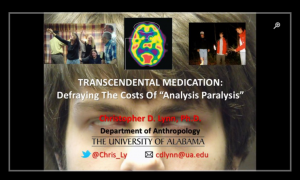
Lots of implications here, but I am reminded of Mel Konner’s 1985 piece called “Transcendental Medication,” in which he suggests that one of the reasons ritual behavior among the !Kung probably takes place at night is because the firelight becomes so hypnotic in the dark & fascilitates the altered states of consciousness that are part & parcel of possession culture (actually, it may just be implied in Konner’s essay, but also told me this personally when he visited Bama a few years ago to given an ALLELE lecture called “Childhood Evolving”).  Michael Winkelman has probably addressed this as well, but it would go a long way toward explaining why shamanistic rituals & spirit journeys often feature transformations into animals or human-animal mutating, whether or not psychopharmacological substances are involved.

Share
Posted in Activities, Evolution and Psychology, Evolution in the Classroom | Tagged , , , , , , , , , , | Leave a comment

2012′s Cheap Thrills thru Evolution in Review

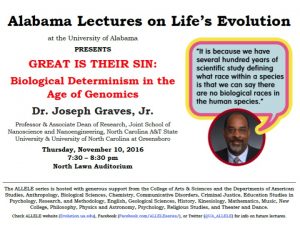
I look back on top posts of 2012, while ALLELE speakers Eugenie Scott & Greta Schiller educate students

I look back on top posts of 2012, while ALLELE speakers Eugenie Scott & Greta Schiller educate students in the background

I sit in Highland, NY at my in-laws’ watching crappy bowl games (Rutgers v. Va Tech, can either of you find an offense?), reading a cool manuscript draft about psychoneuroimmunological disparity in monastic cemetery remains for my friend Sharon DeWitte, & looking for excuses to avoid composing my spring syllabi & revising an NSF proposal due in two weeks.  Lo, inspiration appears from the blogosphere in the form of Patrick Clarkin’sReview 2012” & Daniel Lende’sNeuroanthropology — 2012 in Review” (which gives props to me, Jason DeCaro, Max Stein, & Bama Anthropology!)  I will write about my own 2012 writings.  What a great idea!

2012 is the year I began blogging.  Such a grandiose & self-indulgent exercise!  How many highlights can I possibly have for only having written for 12 months (10 actually, as I first posted in March)?  As it happens, I have posted nearly 50 times on this site alone (not to mention posts on the newly established Anthropology Blog Network), & those posts have approximately 9,600 combined views.  Yes, I counted.  I included blogging in the required Biosketch for the NSF proposal, so I’m monitoring any of my own fluff that makes me sound synergistic.  Seriously though, as John Hawks pointed out to us on his visit last month, we can do more service for our disciplines by posting on a no-cost blog site than any number of high-cost websites or other outreach efforts.

That astounds me.  I thank all of you who read (or just clicked–gawd knows how little of what I click on I actually read), commented (on the posts or, usually, on Facebook), & posted/re-posted/tweeted/re-tweeted/etc.  I’ve really enjoyed blogging.  It’s made me realize that I can love writing again.  I wanted to be a writer growing up but came to the realization that I have no imagination.  So I turned to academia & scientific writing.  Scientific writing is mechanical & painfully unsatisfying.  It is largely soul-less if it is good.  I love blogging because it has a focus, but there is also this freedom to blather on like I’m doing right now.  It’s like urinating when you’ve been holding it in too long.  Necessary, pleasant, & thoroughly undignified.  The other thing I love is that there is a community of bloggers out there with which I feel I’m beginning to connect.  There are many others doing far more scholarly writing than I, writing more regularly, etc.  Nevertheless, the pings & retweets from them give me the illusion of being part of something, & an imagined community is better than no community at all.  So thank you all for a good year!

Following are the top 10 posts I made this year, based on your clicks, & a brief word on what my point may have been (I am totally ripping you off here, Patrick–buy you some sort of drink in Knoxville next year, for the sake of my utter shamelessness?).

10. HBES 2012 Roundup 2: Brian Hare’s Chimp/Bonobo Cognition Plenary, Mommy Brain Fogs, & Baba Brinkman Evolution Raps (June 20) — The 10th most-read piece I wrote this year was part 2 of a summary of the Human Behavior & Evolution conference talks I went to.  It included discussion of primatologist Brian Hare’s plenary, a talk by Doug Kenrick, my introduction to the “lipstick effect” & other applications of evolutionary psychology in economics,  Laura Glynn’s plenary about pregnancy brain, a cool talk about the connection between smoking & the behavioral immune system, & gushing over Baba Brinkman’s evolution rap performance.  172 views.

9.  Are We Confusing Self-Deceptive Enhancement with Illusory Superiority? (May 20) — I was trying to tease out distinctions in the uses of theoretical constructs like self-deception, self-deceptive enhancement, & illusory superiority & inferiority.  Add to that positive illusions, the Lake Wobegon effect, & the better-than-average effect, among others.  178 views. 

8. ALLELE: Alabama Lectures on Life’s Evolution(April 15) — This was a summary of the 2011-12 lecture series associated with the University of Alabama EvoS program.  It includes remarks about evolutionary psychologist Brad Sagarin, evolutionary biologist Paul Ewald, documentarian Greta Schiller & NCSE executive director Eugenie Scott, archaeologist Brian Fagan, paleontologist Ryosuke Motani, & primatologist Frans de Waal.  This post has been viewed 197 times.

7. Becoming a Lightning Rod for Controversy by Starting an Evolutionary Studies Program in Alabama: Part 1 (March 8) —  This was my very first blog post.  It was about how great an idea it is to start an EvoS program when you are an untenured professor.  The jury is still out in terms of being a boon or a bane to tenure, but it’s been successful, fun, & totally worth it so far.  288 views.

6. Remembering Brent Colyer: Serotonin, Alcoholism, & Evolution (December 12) — One of my longest-term & best friends died on December 1.  This was a remembrance of his life as it influenced mine & frustrated puzzling over proximal & distal factors in his untimely death.  I’d like to think that 474 views in just over 2 weeks is a testament to the number of people who cared about Brent.

5. Biological Anthropology Blogs (May 8) — Before setting up the Anthropology Blog Network & requiring the blogging by my “Principles of Physical Anthropology” students, I surveyed the bioanth blogs out there.  I wanted the students to be able to see how other people in our discipline were writing on the internet, so I collected them here.  This needs to be updated, but continues to get a fair amount of action nonetheless.  590 views.

4. Were the Canela the Human Analog to the Bonobo? (April 12) — In considering the oft-cited contention that bonobos are our closest relative, especially with regard to our sexual behavior, I discuss the Canela, who were once much more promiscuous than most any other culture we know of today.  This post is based on readings & a lecture I give in the spring human sexuality course I teach, though I may need to revisit this at some point, as it’s not particularly nuanced.  I think it’s important to characterize us as diverse, rather than like any other one species.  Anyway, 857 clicks on this one.

3. (Food Erections, Gorilla Prozac, Bonobo Cunnilingus &) Apes in & at the Nashville Zoo (March 15) — This was a summary of some of my favorite visits to zoo primate facilities.  I’ve seen chimps at the Montgomery Zoo with erections at meal time, a gorilla at the Memphis Zoo on Prozac to help it with anxiety so it can mate, & bonobos at the Memphis Zoo whose (possible) cunnilingus behavior I’m still looking for a student to study.  I think the gratuitous picture of the bonobo vulva gets this post a lot of clicks.  People are weird.  1,234 views.

2. Penis Diversity is Our Business (June 10) — Speaking of weird, this is a post about the diversity of penises in the animal kingdom.  I was inspired by a piece by Darren Naish about weird turtle penises & a set of images I show in the course on human sexuality I teach, taken from Alan Dixson’s book on sexual selection.  The title is a goof on “Diversity is our Business” by Ulf Hannerz, which refers to my discipline, anthropology.  This has been viewed 1,549 times all of its own accord.  A lotta people like to look at crazy penises.  Go figure.

1. Pivoting around Smartphones & Cigarettes: Evolved to Play in Extra-structural Interludes (May 17) — This was by far the most viewed post.  It’s a riff on play theory, which suggests that mammals of all ages play to learn, prepare for “real” life situations, test boundaries, & wire up our brains. Anthropologist Peter Stromberg uses play theory to examine low-level smoking among college students, which inspired me to consider a similar application to the use of smartphones.  This came out of impromptu discussions in my spring courses, & I even drew up a picture for this post.  However, it was among my least viewed posts until the iPhone 5 came out, & a CNN.com news piece on September 26 about smartphones & boredom picked it up.  This one has been viewed a whopping 3,121 times to date.

Again, thank you all.  I look forward to blathering on about evolution & things tenuously related to evolution for my sanity next year.  Happy 2013!

Share
Posted in Anthropology, Archaeology, Biological Anthropology, Evolution and Psychology, Evolution in Higher Education, Evolutionary Medicine, Mating and Sexuality, Paleontology, Primates | Tagged , , , , , , , , , , | 3 Comments

Mating Intelligence Unleashed is now unleashed!

Good news (at least for me and Scott Barry Kaufman!) – Mating Intelligence Unleashed: The role of the mind in sex, dating, and love has just been released. This book, the product of a great deal of time and energy – along with at least some blood and sweat – started as an idea that Scott and I discussed at a mall in Connecticut in 2005. Long time coming! Along the way we collected a world-class scholar to help with our foreword (with none other than THE Helen Fisher) and a world-class publisher to make the book happen (Oxford University Press). Yeah, we’re happy about this!

Designed to be an accessible follow-up to an edited volume on this topic that I co-edited with Geoffrey Miller (Mating Intelligence: Sex, relationships, and the mind’s reproductive system), we hope that this book sheds important light on issues of human mating. By integrating scholarship on the topic of human mating, evolutionary psychology, and intelligence, this book is designed to provide a fresh take on such issues as:

- what sits at the core of human mating motives
- why men and women are sometimes similar and sometimes different in the world of mating
- why some people seem simply smarter in the world of mating compared with others
- how mating psychology fits in with the broader areas of personality, social, developmental, and cognitive psychology
- how mating and parenting are inextricably linked domains of being human
- how mating psychology interfaces with such important societal issues as health and education
- and more!

The book’s not very expensive – and we hope it strikes a balance between being engaging and accessible on one hand (we have lots of snarky subtitles!) and being useful for serious scholars and students of psychology (we have 35 pages of references to both classic and cutting-edge scientific literature in this field) on the other.

We also have a whole section about the Mating Intelligence Scale that we wrote for a cover story that Psychology Today published on mating intelligence in 2007 (Thanks Kaja Perina!). We’re hoping that readers find it fun, helpful, and interesting.

This all said, I want to briefly comment on the breadth of our conceptualization of the term “mating.” In the field of evolutionary psychology, mating reaches beyond sex. From an evolutionary perspective, mating includes (or relates importantly to) the following aspects of humanity (all of which are addressed in detail in our book):

- acts of human creativity, such as art, humor, and music
- behaviors that permeate one’s social interactions and behaviors in groups
- acts designed to impress (implicitly or explicitly) potential partners
- acts that underlie the nature of love
- important connections with parenting and family
- behaviors that relate to relationships that last across decades
- and lots more

Often, in lay terminology, “mating” is equated with sex. And granted, our book’s subtitle includes the word “sex” – and our book cover (thank you Oxford!) is pretty sexy – but, that said, modern research on mating psychology is really about much more than sex. In important ways, as you’ll see in our book, it’s largely about the experience of being human. We hope you find our work entertaining, insightful, and helpful. And yes, if you bring either of us a copy and a sharpie, we’ll sign it! Happy reading!

References

Geher, G., & Kaufman, S. B. (2013). Mating intelligence unleashed: The role of the mind in sex, dating, and love. New York: Oxford University Press.

Geher, G., & Miller, G. F. (2008). Mating intelligence: Sex, relationships, and the mind’s reproductive system. Mahwah, NJ: Erlbaum.

Share
Posted in Uncategorized | 5 Comments