EvoS Journal: The Journal of the Evolutionary Studies Consortium Volume 11, Special Issue 1, 2019
Title Acetaminophen Does Not Alter the Early Processing of Emotional Facial Expressions: An Eye-tracking Study
Author(s) Gallup, A. C., Gagnon, B. K. L., Rosic, B., & Eldakar, O. T.
Abstract A growing body of research has uncovered that acetaminophen, the most commonly used over-the-counter painkilling drug in the United States, produces a number of unintended psychological effects. In particular, recent studies show that acetaminophen blunts a variety of adaptive affective and cognitive processes, including our sensitivity to painful social experiences and subjective responses to emotional stimuli. Using a double-blind placebo-controlled study, here we examined whether acetaminophen alters the early visual processing of emotional facial expressions. Participants consumed 1000 mg of acetaminophen, or a matched placebo, prior to performing a delayed disengagement task with different facial expressions. Specifically, we used eye-tracking software to assess the latency to look away from neutral, happy, and angry faces. Based on prior research, we hypothesized that acetaminophen would reduce the typical delay in disengaging from emotional expressions. Our findings showed a significant main effect of facial expression, with happy faces producing the greatest delay, but there was no difference in response between the acetaminophen and placebo conditions. These results indicate that acetaminophen does not alter our initial assessment of emotional facial expressions, but we suggest further research be conducted to examine how this widely consumed drug may alter the detection and perception of emotions in others.
DOI TBD
How to cite this article: Gallup, A. C., Gagnon, B. K. L., Rosic, B., & Eldakar, O. T. (2020). Acetaminophen does not alter the early processing of emotional facial expressions: An eye-tracking study. The Journal of the Evolutionary Studies Consortium, 11, Sp. Iss. (1), 34-43.
Evolutionary approaches to human behavior often try to “carve nature at its joints.” This phrase, somehow evocative of Pinocchio, means that when we try to describe or classify psychological phenomena, we shouldn’t use just any old arbitrary organization scheme. Rather, we should base our thinking on underlying natural, evolutionarily informed, realities.
This principle is especially salient to evolutionary clinical psychologists, because psychotherapists are encouraged to each develop their own “orientation,” which is a particular way of thinking about where psychological distress comes from and informs how it can be treated. The orientation is unique to each psychologist but is typically created in part by assembling elements from a number of the most common established orientations, and usually (though not always) picking a primary allegiance: psychodynamic, humanistic, cognitive-behavioral, and family systems are among the most well-known orientations. Each of these orientations has its own distinct perspective on the nature of psychological distress, its own history, traditions, and associated therapies. While cognitive-behavioral is often considered to be the most scientific-minded of the orientations, the truth is that there is good science supporting the efficacy of therapy from each of the orientations (and plenty of bad science in each); and crucially, there’s very little evidence that any orientation is vastly more effective than any of the rest!*
Thus, the evolutionary clinical psychologist faces a paradox: How can we think about uncovering the “true” nature of psychological distress and mental disorders if any old way of thinking about psychotherapy is just as good as any of the others?
The resolution, in my view, is to focus on what elements all the orientations have in common. Looking past all the differences, what similarities do we see? If we get to the bottom of what these common factors are, we’ll have a better sense of the true mechanisms of psychotherapy, and thus a more satisfying and universal explanation for psychological distress and its treatment. Because, to me, for whatever reason, admitting that there’s a set of totally different points of view, all of which are equally valid, just doesn’t have that satisfying scientific ring to it. To me, it’s no kind of answer, but rather an invitation to ask further questions.
As it turns out, one thing that all effective treatments based on legitimate orientations do (intentionally or not) is get the client in touch with — and working WITH, not against — their naturally occurring emotions.
By this, I mean not just any old emotional reactions that people engage in, but the emotions that were naturally selected as appropriate responses to situations. For example, for a person with crippling self-doubts, fear is a situationally appropriate (although maybe exaggerated) emotional response to the possibility that others will judge you. Explosive anger towards your boss who asks you to give a presentation is not necessarily appropriate, if that anger is a way to avoid the real core fear of judgment. Treatments derived from each of the orientations go about this emotional approach in different ways.
Psychodynamic therapies do this by encouraging outward expression of unconscious, suppressed, repressed, or misdirected emotion (going back to Freud’s recognition of the power of “catharsis” — the sudden breaking-through of that true emotion). Humanistic therapies do it by fostering the therapist’s unconditional positive regard for the client, allowing him/her the space to guide him/herself through whatever emotions may arise on the journey to self-actualization. Cognitive-behavioral therapies teach skills to help the client examine and approach distressing thoughts and situations, which ends up resulting in the expression of long-avoided emotions (often, but certainly not always, fear or anxiety).**
Thus, a researcher seeking an evolutionarily informed understanding of why people encounter emotional disorders and adjustment issues (by this I mean clinically relevant depression, anxiety, post-traumatic stress, etc.) should focus, in large part, on this core mechanism of emotional avoidance, and how it so frequently pops up and gets in the way of our mental health in modern society.
If this perspective is true, it inevitably invites the question of why people seem to need so much help engaging in what evolutionists would consider to be a naturally selected adaptive function — something that should be a biologically primary ability! This is an important question, and whether the disciplines of evolution and clinical psychology can be reconciled depends on our ability to resolve this paradox. I’ll explore some thoughts on this in Part II of this entry (coming soon).
———-
*If the therapist’s orientation isn’t the most important determinant of therapy outcome, then what is? It turns out, it’s the quality of the alliance between the therapist and the client.
**I’m not necessarily advocating here that all orientations are equally good for all clients/issues — or even equally good overall. Nor am I saying that a therapist’s orientation doesn’t make any difference at all. However, I view that matter as a somewhat orthogonal point to the one I’m discussing here.
Posted inUncategorized|Comments Off on What All Good Psychotherapy Has In Common
See previous post I, II, and III in this series, or related posts to this month-long trip here and here.
Note in our previous episode that I wasn’t sure if I had meetings set up, with who, or about what when I arrived at Ranomafana. I received a message from Dustin that I had a 10AM appointment, but he had not been able to confirm, so I should just ask for Maya Moore or Pascal Rabeson. When I arrived at Centre ValBio (CVB), Maya had left for Tana and Pascal was in another village until later in the day. Nevertheless, I was able to get an appointment for later in the day with him.
In the meantime, I explored the village, taking photos. I came across one of the silk making coops. I couldn’t afford to buy a scarf but was given permission to take photos. However, I overstayed my welcome, taking so many photos of every corner of the room that the coop president (How do I know she was president? I took photos of all the photos and lists of offers and deduced who she was) asked me to pay them 5000 ari for the photos.
I went down to the bridge to the town’s thermal baths and took photos of the bridge they were replacing. It had been knocked out in a big cyclone that hit Madagascar 20 days earlier.
I’m glad I took so many photos. Later, when I was meeting with Pascal, it turned out he was lab mates at the University of Georgia with our close family friend Jon Benstead. Jon had done his dissertation research in Ranomafana when CVB was just a shack in the woods.
The shacks in the woods that used the be the Centre ValBio facilities are still there but unused.
CVB had the best wifi in the village so I shot Jon an email while I was there, and he asked me to take lots of photos of the Centre and village for him, since he hadn’t been there in 18 years.
But let me back up. Because I walked in here rather cold. CVB is a rather famous world class facility for conservation and education. It was started by primatologist Patricia Wright from Stony Brook University (SUNY). I have been meaning to invite Pat Wright for an ALLELE lecture ever since hearing what a great talk she gave at SUNY New Paltz. I have even more incentive now.
Dr. Wright discovered a new lemur species at Ranomafana, the golden bamboo lemur, and established the park to protect it. One of the amazing thing about bamboo lemurs is that they eat young bamboo, which contains toxic amounts of cyanide. So they process it somehow because they don’t die (at least not from cyanide—humans, on the other hand…). The current buildings of CVB were built later. They are a facility that hosts researchers, conducts study abroad, houses both, and provides lab and lecture facilities. They work with the local community to provide vocational training for Malagasy to work in or with the Centre and facilitate and develop cooperatives to promote economic and cultural sustainability, such as the aforementioned silk cooperative. My nature guide Rodan said, “Pat Wright is like a mother to us all, to the whole village of Ranomafana.”
Lova told me abut the MRMW project and the education efforts more generally. Those involve efforts to train teachers to provide conservation and science-related education in remote village and at “road” schools, or those reachable without too much difficulty by car and the main road.
By the next meeting with Pascal, I had a thought on how we could collaborate. I told them about our project and we arranged for them to send us their lessons which we will curate and share on our website. Their programs were developed in conjunction with American educators but are only being implemented in limited schools around the park. We will put them in a format that can be used by our teachers in the US, Greg’s class in Costa Rica (more on that later), and Eagles Wings in Tana, and other schools around Madagascar and the world (maybe yours?). We will link the material back to CVB to ensure credit but hopefully extend their reach of the material.
On the surface, these things don’t seem so complex they could not have been done by email. But it’s easy to send an email and just as easy to ignore. It’s equally easy to say yes in an email and not follow through. There are no stakes to an email. But taking the trip to Madagascar, to go to see how a partner is doing what they do means a lot, I hope. I intend it as a strong signal of commitment. It enables us all to vet each other using our senses and guts and to establish a rapport and trust.
Let me reiterate: There is nothing out there to give guidance for teaching 4-field anthropology at the primary school levels. There are things here and there, but what we are creating is a unique resource and testament to the value of and excitement for doing it.
Lova gave me a tour of CVB after my meetings. Then I rendezvoused with my guide for a night walk. I was pleased to be able to see and photograph several mouse lemurs and chameleons.
The chameleons were very very cooler—cooler than I expected—but LEMURS!
See previous post 1 and post 2 in this series, or related posts to this month-long trip here and here.
The drive to Ranomafana is about 12 hours. After experiencing the Tana roads, I thought maybe it was close via bad roads, but it’s really 12 hours in a 4WD at relatively high speed but through winding roads. For 12 hours, I was tossed side to side, tires screeching on the road.
I was very passive in this adventure, which is ironic when I think that this project arose because the TMSE PTA asked me to offer an anthropology course several years ago when my kids were in 3rd grade. I didn’t want to do it because I didn’t have the time to take on any more service, but I wanted to do it because I wanted to be able to share what I do with my kids and help their school. I remember discussing it with DoVeanna Fulton, then chair of Gender and Race Studies, whose son had been a classmate of my kids. She said, ‘if you wait till you have more time, will your kids still want you to do it and will there still be an opportunity?’ Thank you, DoVeanna.
So, Duke Beasley and I collaborated on the course that first time, and it went well that first time. But only my sons Lux and Jagger took it. The next year, Bailey wanted to take it, so Duke and I offered it again. Still, I was never going to do it again, but it was popular and I’d got a curriculum developed that I could hand off to students to teach, so I kept it going. Later, I recognized an opportunity to turn it into a service learning course when I saw an application to develop a community service course. At the time, I had another course in mind and didn’t realize I was already doing one. Then later, Jason DeCaro came across a Wenner-Gren Foundation grant call because he was flying to New York and would be meeting with president Leslie Aiello. So I threw together a proposal, got feedback from her, tweaked the proposal, and got funding for this project.
I met Dustin Eirdosh, who has been my liaison on this Madagascar collaboration, just as serendipitously in a way. He was working with David Sloan Wilson and the EvoS Consortium for resources and in touch with Becky Burch. I started contacting Dustin to brainstorm about collaboration potential and saw that his energy is similar to mine. So I say “passive” when I describe my activity in Madagascar, but what I really seem to do is flap my wings hard and fast like a hummingbird until an opening appears, then I hit it hard and without hesitation.
I set this trip up without any real game plan. I deferred to Dustin and Josia to give me a lead that I would then take. So it was Dustin who suggested a trip to Ranomafana and Josia who booked the driver for me. The first one got in an accident the day before, so she arranged the second one at the last minute. She used the same company she books for her own research, but I’m not sure that that was the same in both cases.
The driver was going to cost 140,000 ariary/day (around $50/day, 460,000 ari total). Gas would cost me another 420,000 ari for the trip. Then I would need hotel for 3 nights, which I found for 100,000/night. That’s about $400, not including food or other things. That’s a sizable amount of money, considering I had no specific plans of who I was going to talk to or if I would even be able to get a meeting and had very little money with me.
This was covered by grant funding, but universities never want to give you your grant money up front. They want you to pay it out first and reimburse you. Presumably, there’s liability involved. I also think it’s being used in some slush fund somewhere or earning interest. When I asked for a $1,000 advance, I was treated like I was asking for money to go binge drinking. I was told I was asking for a LOAN and that it is against state policy to LOAN employees travel funds. Load of crap. We researchers have rents or mortgages to pay back home when we travel. Sorry to tell the world, but you don’t get much financial compensation for a PhD in the social sciences and humanities. I’m so deep in debt from student loans, I will never be free (see the notice of being served because of my student loan debt from the first day of this trip).
So $400 is a lot for money for me, as I was traveling exclusively cash and carry, with nothing in a bank account I could access and no place in Madagascar takes credit cards. What an adventure, right? This means I was riding for 12 hours in a car to meet with people I didn’t know would meet with me about what I didn’t exactly know and not sure I’d have enough money to pay the driver when I got back.
Jao gripping the wheel.
But this is not a mystery story, so I’ll let you off the hook. I stressed on the ride, tallying up my expenses, especially when Jao, my driver, stopped at a tourist hotel restaurant for lunch to eat “normal” food. Normal for me, is what I think he meant. Also, “clean,” he said. But it ended up costing me a pretty penny. The next meal was a little better, but I had to keep pushing him: “Let me worry about the food poisoning. Let’s eat Malagasy food at hotelys.”
If there are traditional musicians selling their CDs at the hotel restaurant, it probably costs more than you want to spend for a quick road stop. Or if there are old New Yorkers talking loudly at the table behind them.
And I had to ask Jao to help me change currency so I could pay him. Banks there won’t change $100 bills, which is all I had. And we were returning on a Sunday when everything was closed. So we had to meet a black market money changer by the side of the road on the way back into town. I don’t mean to make this sound in any way like Romancing the Stone or Indiana Jones crap. Other field researchers have a million such stories, as do all the people who live in such countries. And they are unfortunately not rare in the world. I borrowed my money belt and steel-reinforced bag from a friend who regaled me with stories of dealing with a cholera outbreak, regularly carrying vast quantities of cash on her to cover field school expenses, meeting sketchy money changers in strange homes, and drinking with murderous warlords during her field seasons. It’s all a matter of perspective. But this time, I was in Africa, while she was back home attending the premier of Beauty and the Beast!
I took lots of photos as Jao drove in silence. He listened to music all the way back. At the first, I felt bad he had obviously not felt comfortable playing music in the car until I heard him playing Otis Redding and asked him to turn it up. We listened to that and a Beatles album on the way back, which I loved singing along to, but then the next 9 hours were taken up by bad 80s hair metal and Celine Dion. And I was stuck with only Neil Gaiman’s new Norse Mythology as my Audible book. It was interesting for about an hour, but then stories of Thor’s dumb brutishness and Loki’s selfish mischief just lulled me to sleep.
However, the Betsiloa countryside was beautiful. They are the tribe that occupies the highland south of Tana. Their homes are tall and made of red brick that matches the red clay of the ground. Their terracing for rice, corn, and other produce is more distinctive than terracing elsewhere (I got great photos of this but—foreshadowing—those photos are sadly no longer with me). Apparently, they get three annual harvest, where other only get 1-2.
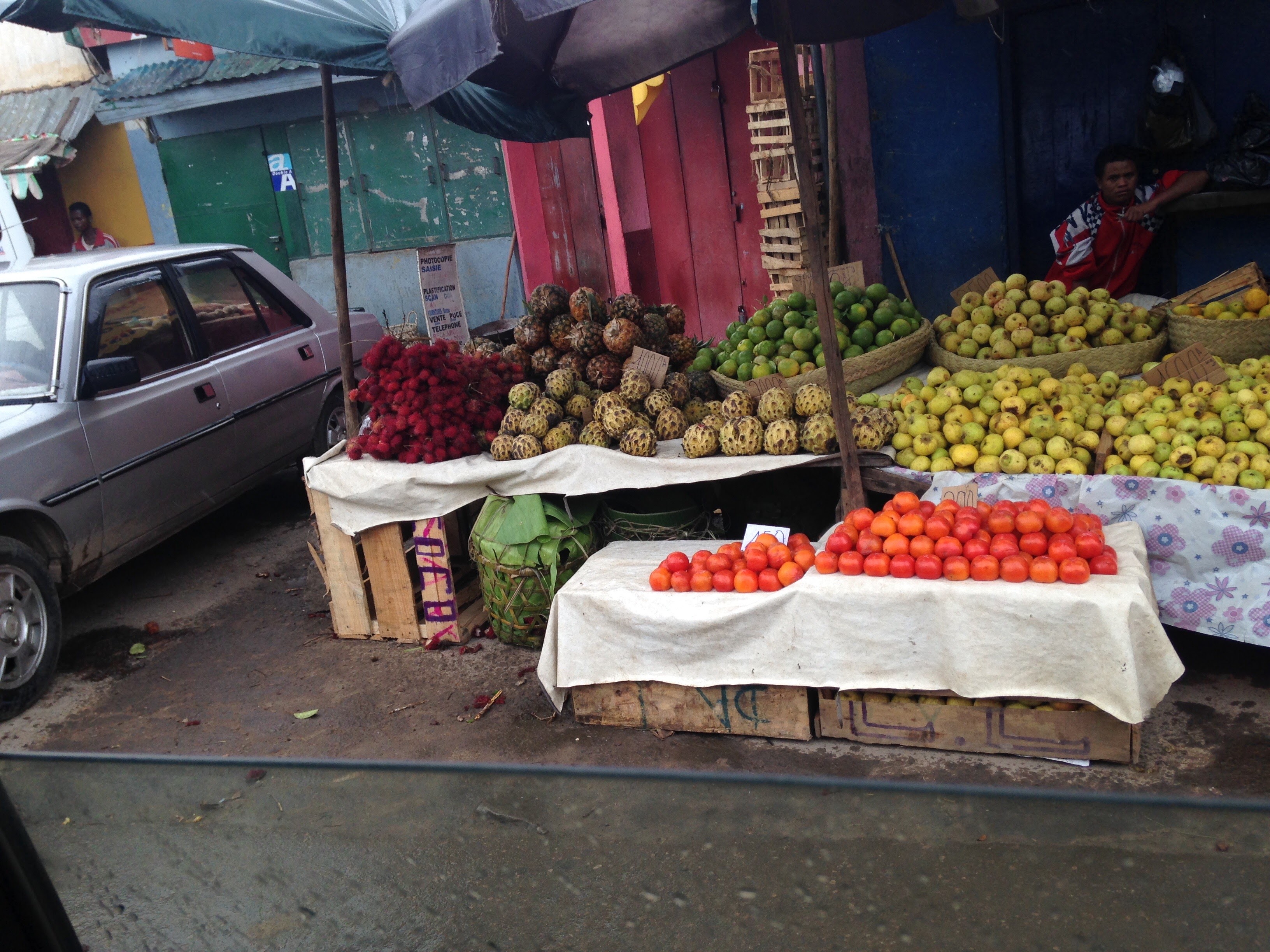
As we passed through Antsirabe, suddenly there were colorful tricycle taxis everywhere. “City of Pouse-pouse,” Jao told me. The region is resplendent with bicycles and pouse-pouses. I couldn’t get enough photos of them and the colorful markets (alas, many of those also lost with someone on the road to perdition—okay, maybe a little harsh, but I’m very annoyed about it).
We rolled into Ranomafana around 4, a bit earlier than expected. I got a place at Hotel Cristo, which came recommended both by Lonely Planet and Josia and Rija. It turned out to be very lovely.
Again, in true colonial style, I sat on the veranda watching the sunset over the rainforest and Namorona River, while people spoke Dutch and English nearby, and brown-skinned hotel employees brought me a double expresso. But at least they owned the place this time. Dear Malinowski…
Anthropology is Elemental is currently funded by a grant from the Wenner-Gren Foundation.
Repost from April 2017 on Bama Anthro Blog Network. See that post for photo galleries missing above: https://wp.me/p2SN82-h8
I’ve been jet lagged from the 8-hour time difference and keep waking up at 2:30 AM, unable to go to sleep. After a day or two, I remembered I have Starbucks instant coffees in my bag. I got some hot water from the sink and hazarded a coffee in the middle of the night to get me going enough to get some work done. Later I checked and learned that the water has some dirt in it, but, according to Jurgen, the owner of Villa V where I am staying, the German Embassy actually had it tested, hoping it would be found undrinkable and merit them getting raises for working in an undesirable location. It’s got some silt in it but is fine otherwise. No raises for them, no dysentery for me.
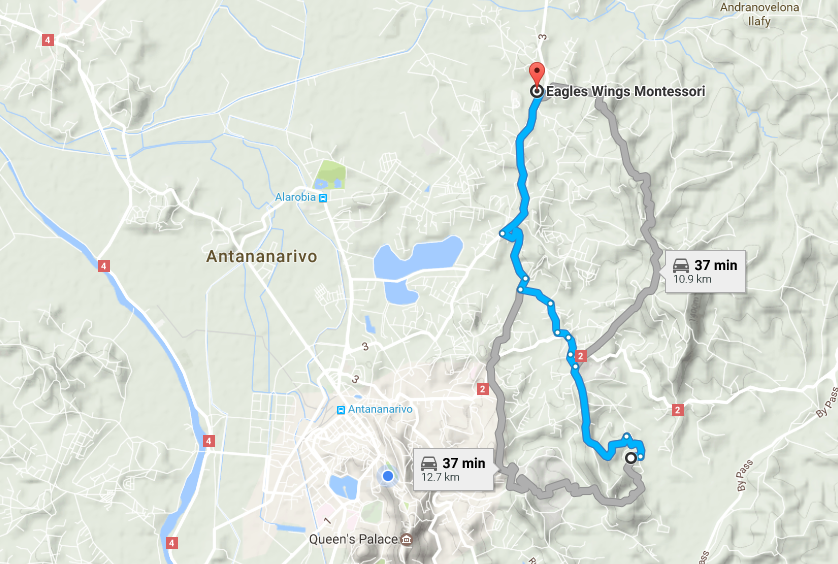
It says 37 minutes but generally took over an hour to make this trip because Rija would get stuck in traffic, much to his delight (he did not enjoy this).
I spent Monday and Tuesday going to Eagles Wings Elementary and Middle Schools. The elementary is run by Omega Rakotomalala, who gave me a tour of the four classes spread across three buildings.
With Omega & Tana behind us.
The first two EW Elementary buildings are across an alley of sorts from each other. The third is a mile or so away, and we had to drive there. I observed the first three classes, which were two pre-K age classes and a 6-9 year old class.
When we went to the other building, I sat in circle time with the 10-12 year olds and chatted, had lunch, watched them play soccer outside.
Then spent the rest of the day showing them how to use the iPad to make a video. I had them pass it around, introduce themselves, and edit it to include their names. We went back to the 6-9 year olds later and recorded them singing the Eagles Wings theme song to add on at the end.
Middle school kids working on a video on the iPad purchased with Wenner Gren funding for our cultural exchange.
We did roughly the same thing on Tuesday but with the older kids. They were a bit more intransigent, but, on the other hand, Josia had me give them a bit more of a lecture on what anthropology is. We did a few activities, such as primate relay races, to get them up out of their seats and involved. According to Josia, it went over very well. They paid more attention than usual, so I consider it an all around success.
Eagles Wings Middle School & friends
One of the more exciting things to come out of the few days was the realization that Eagles Wings has teaching opportunities for my master’s level or above students that includes room and board and a little stipend for food. During the year, the middle school is looking for native English speakers (Eagles Wings teaches in English) who might want to work in country while conducting research. Alternatively, there are opportunities to help out with summer workshops for those who can’t go during the school year. Either way, it includes room and board in their offices. Also, Josia could take students to the field with her when she collects data for their ethnoprimatology project. This includes lemur observations, as well as interviewing local people about their relationships with the lemurs. There would be opportunities for collecting additional data in the course of this. For students who stay at least a year, they have means of defraying or paying the travel costs to get there. I’m really excited about presenting this opportunity to my quality students.
University of Antananarivo campus
On Wednesday, I met with faculty from the Anthropology and Experimental Natural Science Education departments and gave talks at the University of Anatananarivo. Their anthropology department focuses on humans and environment, genetics of origins of Malagasy, and assessing diachronic variation of human character (which I took to mean environment and development of human, health, growth and development, and human biology). Their department was very interested in developing a collaboration with UA. They asked if I or any of our biocultural doctoral students would be interested in being visiting lecturers, anywhere from a semester to a few weeks before heading to the field to do research. There were several good questions after my talk, despite my concern that my inability to speak French or Malagasy might hamper our communication. However, since the students need to speak English to attend the mandatory field schools hosted in conjunction with Northern Illinois and Bristol Universities, they all seemed to follow along. Their department chair asked what kind of support I had in mind when I discussed our future collaboration, since many of their students cannot get funding to go anywhere to conduct research. I suggested that they are in a position to collect data in Madagascar to compare with similar data collected elsewhere, such as the PATHS study Michaela and I are conducting, that would give them to the opportunity to co-author publication in US and Europe-based journals. This would enhance their chances when applying to U.S. or European graduate programs. This seems to have been appealing—when I asked if anyone wanted a business card, more hands shot up than I had cards to distribute.
This is all very exciting and has my mind reeling. I want to figure out how to harness this energy and excitement before I return home and tumble headlong into the next deadline without processing all of these experiences.
Anthropology is Elemental is funded through a grant by the Wenner-Gren Foundation.
This is a repost from April 2017 on the Bama Anthropology Blog Network: https://wp.me/p2SN82-g2.
I arrived in Madagascar last Saturday afternoon and was greeted for the first time anywhere by someone holding a sign with my name on it. I’ve arrived! Actually, I have arrived, literally. I wish I had taken a photo.
I am here on a diplomatic mission, of sorts. I received a grant from the Wenner Gren Foundation to expand our Anthropology is Elemental program. The program entails posting our lessons to a new, improved, open-access website, video blogging our lessons to share with partner schools, providing resources and training for the partner schools to share their experiences with us, and producing a book of our lessons that other educators can use.
Josia Razafindramanana, her husband Rija Rasamimanana, & their son Hary, Rolling Tide (notice the hats!).
Our partners are Eagles Wings Montessori School in Anatananarivo (aka Tana), Madagascar, Big Red Earth, NGO, and (now) Centre ValBio in Ranomafana, Madagascar (more on them in a later post). I connected with Eagles Wings and its middle school director Josia Razafindramanana through Dustin Eirdosh of Big Red Earth. Dustin started an EvoS program when he was in Toliara.
We’ve spent the past several months figuring out how to produce video blogs (see below for my first effort) and moving our material to a new website, which are now becoming accessible via our website anthropologyiselemental.ua.edu (follow us on Facebook to learn about our updates). I am in Madagascar to get the face time to make things actually happen, to bring a few high-end iPads to Eagles Wings, and to establish other contacts in Madagascar.
Before leaving North Carolina, James Loudon (and the Lonely Planet book I purchased for the trip and just started reading on the plane) warned me about the extreme poverty of Madagascar. Driving from the airport in Ivato to Tana, which took about 45 minutes, the poverty didn’t appear qualitatively different than other developing and even developed countries I’ve traveled in. The living conditions remind me of places I’ve seen in Ecuador, Costa Rica, and American Samoa. But I think the degree is different. There is much more intensity of that life here, at least in Tana. I’ve been told variously there are 2-3 million people in Tana. And they are crammed into a tight space. Traffic is a nightmare, and the roads are the worst I’ve ever seen. I cannot imagine driving here. I would not want the liability. Pedestrians are given the benefit of the doubt, and so it is recommended that drivers be hired to put a buffer between you as outsider and the local law enforcement if something goes wrong.
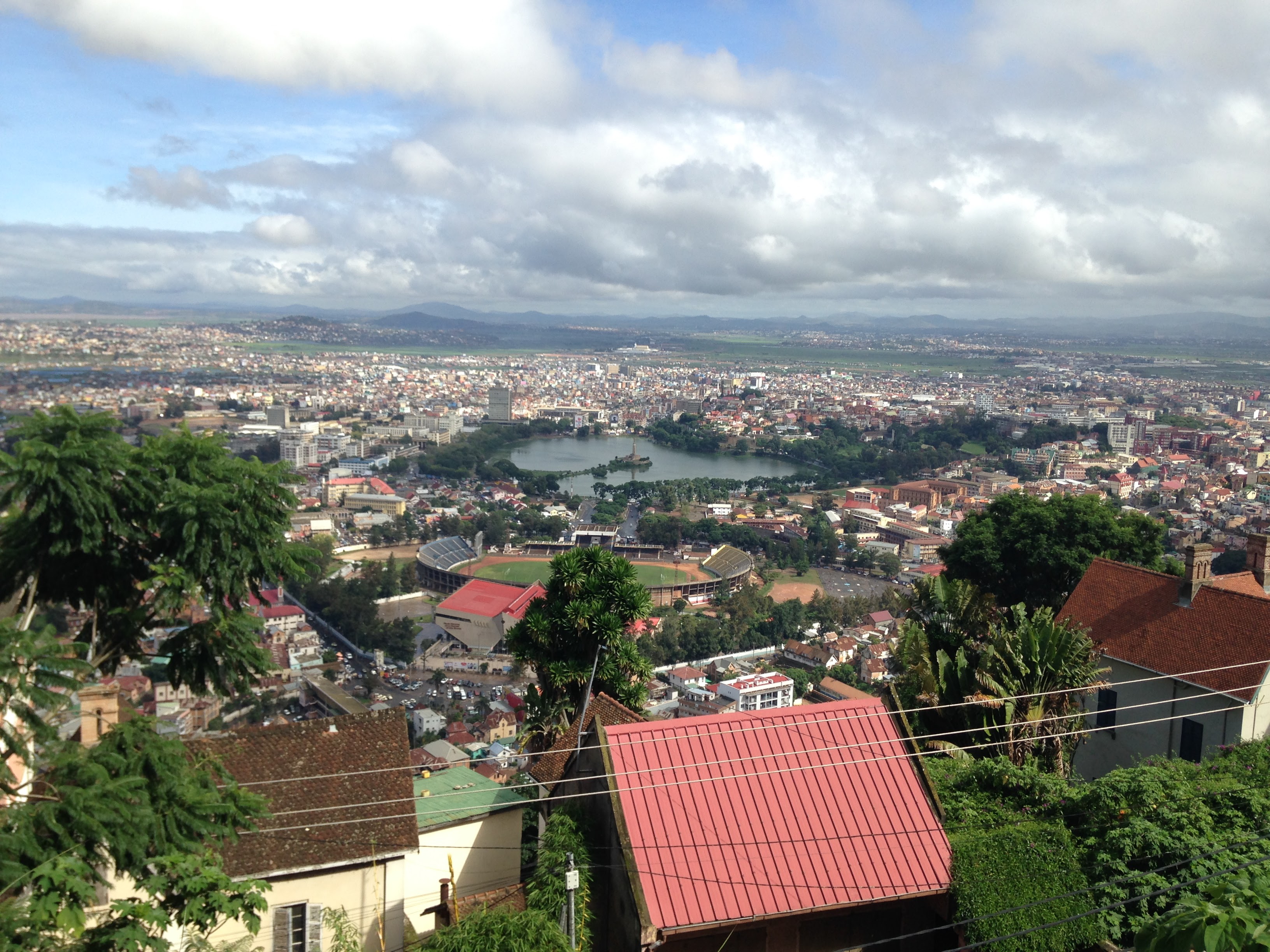
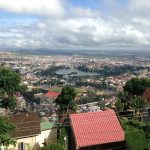
View of Antananarivo, Madagascar from Haute Ville (Upper Town).
I spent the first morning doing the Lonely Planet walking tour in the rain of the area I was in, but there were few streets names on the book’s map or in real life, so I found myself going in circles and walking down and up the city’s steep streets and steps. Eventually I found my way to my objective, the royal palace of the Merina dynasty, where I was fleeced by the guides waiting outside the palace for people like me who hadn’t memorized the exchange rate yet. Nevertheless, I enjoyed what I could understand of the tour of the palace grounds.
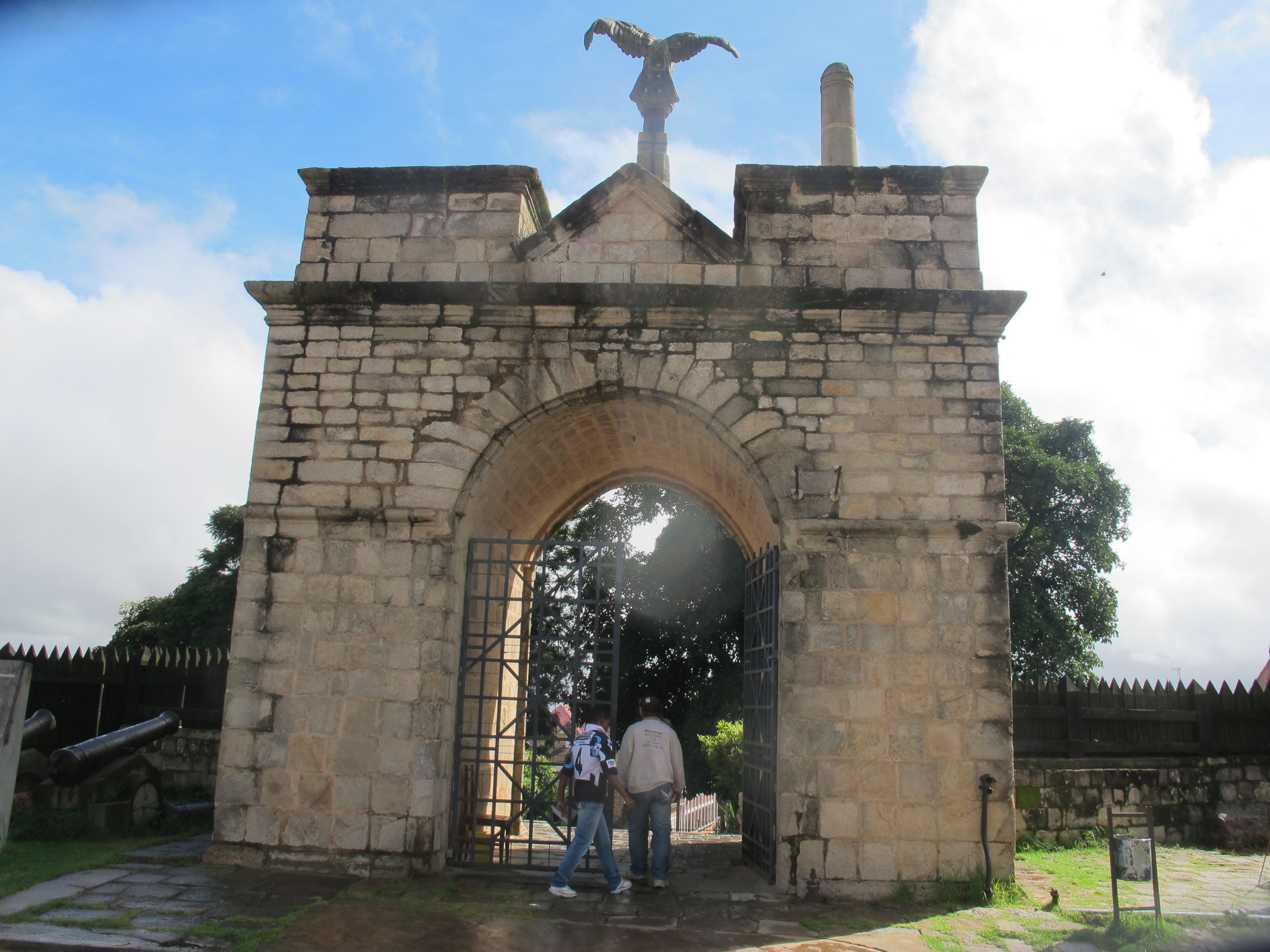
The gate to the Rova, the traditional Merina seat of royalty, features an eagle & a circumcised penis, symbols of power.
The “mad” Queen Ranavalona I built the biggest palace that still stands on the grounds. Basically, her husband finished the work of his father by, with the help of the British, uniting the Merina to establish dominion over most of Madagascar. The Merina are one of 18 “tribes” in Madagascar and are probably descended from among the first settlers here, who arrived from Indonesia (later groups came from the African coast). When her husband became king, he killed all his political rivals, as you will, including many in her family. Aside from the fact that theirs was mostly a political marriage and she was one of several wives, there was little love lost between them. He had no heirs and died young. She essentially consolidated power in her favor, took over as queen, then killed her political rivals, as you will. Then she pushed out the foreigners and killed about 20,000 Christians by having them thrown off the cliffs. Apparently, she was big on torture and forced labor in lieu of taxes. Her legacy is told but not with a tremendous amount of pride. Oh, and she kept a lot of lovers. I kept asking about this point. The guide referred to her as “polygamous” until I pressed him, at which point he admitted she was just banging whoever she wanted. I would love to see a movie about her. Or a series on the Starz network.
Queen Ranavalona I
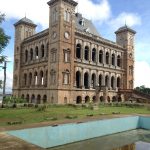
Queens palace and bathing pool
Photos of the grounds before the fire in 1995.
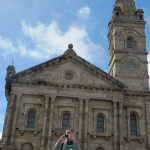
In front of the Catholic Church
My guide and I getting meta
I call this “Palace Akimbo”
The tour of the museum was by another one of the guide team (that also came with “security,” all of whom requested extra payment away from the sight of the museum office).
The circumcised penis symbol of power.
The very gaudy thrown of Queen Ranavalona I.
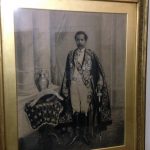
A dowdy Queen Ranavalona I in full European monarch getup.
The prime minister was from not royal blood so he ruled from behind the throne by marrying three successive queens. His house, which is necessarily lower on the hill than the royal palaces and smaller, is now the museum.
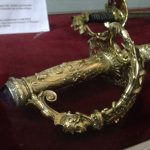
This sword has sapphires on the hilt, which come from Madagascar.
This depiction of the French monarchy as monkeys suggests what the Malagasy thought of them.
I wandered down to the heart-shaped lake at the bottom of the downtown peaks, which has a statue of out in the middle of it. There are no stoplights or signs, so I had to dash across a busy boulevard. What appears idyllic from above and even during the drive in has its own layer of grit. On the way down, two small children were grooming each other like monkeys. Later, they were aggressively panhandling. Next a disabled person was in the middle of the path with his legs displayed askew for maximum effect. Next to the lake, a homeless person was burning bottle caps at one intersection. A ways down, locals were in the lake seining for fish or something. I caught the eye of another woman panhandling, who followed me a ways. The guide book said not to walk on the part where the walkway goes out to the statue. My legs were shaking from the morning’s exertions, and I was tired of being rained on, so there was really no danger of it. What I was more worried about was finding my way back to my hotel.
View up in the rain
Then it cleared
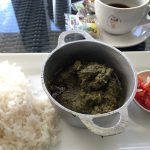
I needn’t have worried. I’m pretty sure I passed it twice in my wandering circumlocutions. I stumbled on it in a matter of minutes. I changed and went to wait for Josia, who arrived shortly with her family (husband Rija and son Hary) and carried me away. We went for lunch at the City Grill in an area that is more of a modern shopping area. I had the rivototo with pork, which a Malagasy dish with grated cassava leaves.
Loved seeing this!
Rovitoto
Hary, Rija, and Josia
I was excited to see an Obama ’08 sticker on the back of their car, so I probed them about Malagasy interest in the U.S. political situation. “The eyes of the world are on you,” said Rija . Madagascar is greatly affected by the African Growth and Opportunity Act (AGOA), which is a Trade Act with the US. It enhances market access for qualifying Sub-Saharan African countries, and Madagascar is heavily reliant on the act for duty-free export of clothing and other items manufactured here to the US. Madagascar seems to have abandoned socialist economic policies in favor of privatization and liberalization and are heavily reliant on these exports to the US. They are afraid that if Trump cancels this duty-free access to the US, they will close dozens of factories around the country that each employ thousands of people. That will mean tens of thousands more people out of work. This will exacerbate their current economic crisis, extending from a coup in 2009 that left the country political unstable and more dangerous. Unemployment and crime have gone up, and tourism is down 50%. It’s a hot mess.
Saw this in passing and loved the color.
After lunch, Josia and Rija took me to their place while we planned our next move, which involved finding me a place to stay closer to their home. They live on the east to southeast edge of town and the school is on the northeast side of town. Traffic is nightmarish in town and they needed to be able to pick me up easily. So we settled on a European-style bed and breakfast called Villa V that was just a few minutes away.
Villa V is owned by a retired German diplomat from the German Embassy. While his politics are humanitarian and progressive on paper, his colonial elitism and ethnocentrism made me cringe over the course of my stay there. I was in a beautiful villa with lush vegetation hiding itself from the outside world. He had created a pool with Jacuzzi and waterfall. Meanwhile, on the other side of his wall was a quarry, where locals mined stone blocks for construction by hand, and their families lived in huts, washing their clothes and selves in the dirty stream that ran through the quarry. For dinner, Jurgen and I sat at separate tables chatting while being served by demure brown people. Occasionally he would address them in French or German, and they would bring us a condiment or something else that had been forgotten.
Women washing clothes in the quarry stream adjacent to the Villa.
Meanwhile, I eat a croissant with coffee. I am very ashamed, but it was good. If its any consolidation, later I got dysentery eating typical Malagasy food at a hotely.
I did stay there for four nights, but after the second night, I took to avoiding conversation with him, as he would linger and launch in again to telling me about how all his workers steal from him and how Malagasies are essentially shortsighted and self-defeating.
I hope what I am doing here can actually be of help and that I am not simply reifying 150 years foreign exploitation. However, the villa was a good price (60,000 ariary per night, or around $20), and I do like wifi, coffee, and a hot shower.
I spent two weeks in Wilmington, NC to work on an article from our Family and the Field Study with Michaela Howells. Our data look fascinating. It’s not so much remarkable as confirmatory and solid. We surveyed over 1000 anthropology graduate students and professionals about the influence of anthropology on their family planning and family dynamics on their anthropology careers. Given that we are both first-generation college students, I think we personally were a little stunned at the percent of our peers who come from educated families and were literally socialized for being academics. We will write a whole lot more about this in the future, but it makes clear why anthropology is so lacking in diversity despite being a discipline that studies diversity.
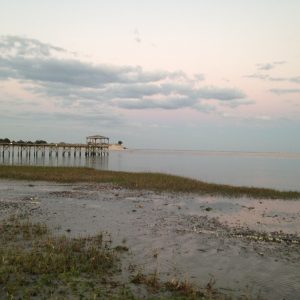
Our friend & colleague Carolyn Jost Robinson hooked us up with a writing retreat at her house near the beach while she was in Indiana on her own writing retreat.
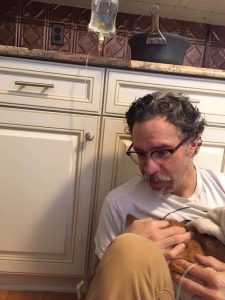
In exchange, we gave her transgender cat antibiotic shots every day & intravenous saline every other day. (Photo by Michaela Howells)
I’m currently listening to Trevor Noah’s Born a Crime, about his life growing up under apartheid, and he repeatedly makes a great point about the responsibility of privilege. It’s not enough to teach a person to fish, you must buy him/her a pole. It’s not charity because the person still has to do the work to fish. But knowledge without the resources to get started or support along the way isn’t enough.
Photo by Carolyn Jost Robinson
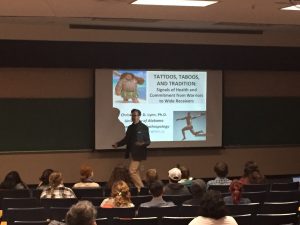
The other main purpose was to give an invited talk to promote my new book. I worked up a talk from my chapter on tattooing called “Tattoos, Taboo, and Tradition: Signals of Health and Commitment from Warriors to Wide Receivers.” The turnout was great. I met with the Anthropology Club for a Coffee Chat for a few hours. The talk was advertised on NPR that morning and was very well attended, with several students coming over from Cape Fear Community College. Afterward, I was treated to some mofongo at a local Puerto Rican restaurant by Michaela, Carolyn, and Bill Alexander.
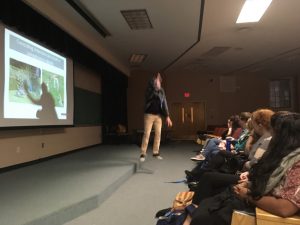
I may or may not have stotted like a Thomsen’s gazelle. What does that have to do with tattooing? I am giving a version of this talk in a few weeks at Binghamton University–you will have to attend and find out. (Photo by Michaela Howells)
In between, Michaela and her husband James Loudon showed me a good time. We went to a fundraiser for Carolyn’s rowing club at a local bar.
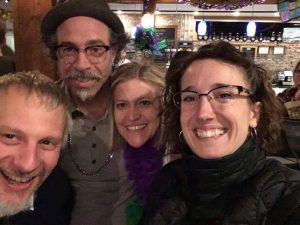
James, me, Carolyn, Michaela at Waterline Brewery (Photo by Michaela Howells)
At the fundraiser, I won a prize for getting the baby in a slice of king cake. It was a massage from a local place that I gave to my hosts (though after lugging all my bags on this trip, my shoulders could use some professional kneading and beating).
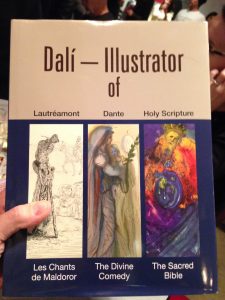
I also won a cool Salvador Dali book in the raffle. The book was so big I had to leave it to be mailed. Go me.
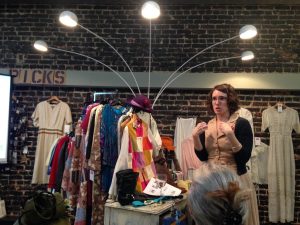
Michaela gave a public talk at a vintage store in town about Suffragettes and fashion that was very cool.
Michaela giving talk “Fashion as Political Resistance: Defiant Fashion, Defiant Women” at Second Skin Vintage, 3/7/17.
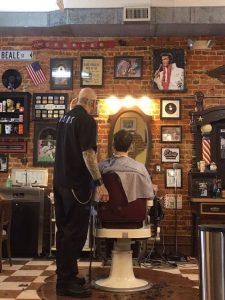
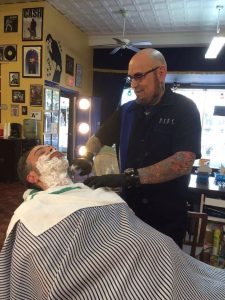
Before her lecture, we went across the street to Beale Street Barber Shop, where I got a haircut, and Michaela treated me to an old-fashioned straight razor shave. I liked the pampering, and the barber-proprietor was very cool–he was an old NYC punk rock guy so we had a lot of common ground to chat about. However, the straight razor cut was like shaving with a dull blade and hurt like a mother by the 3rd go-around. Apparently, I have a tough beard, so he had to go over it several times.
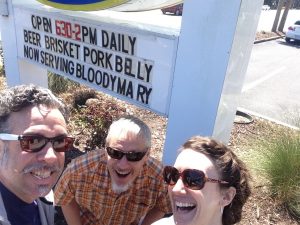
And I tagged along with Michaela and James on their daily trips to the beach to walk with their dog Uli, as well as a spring break day trip to Myrtle Beach to take in gaudy trappings of that tourist hellhole. Apparently, during one of its socioeconomic lulls, there were stripper joints every few steps, but those were shut down and replaced by pancake houses. Yes, pancake houses. Ikr? So we went for some seriously decadent flapjacks at a place that may or may not have been a stripper joint. I have no idea. I had chicken and waffles, with a side of fried eggs and homemade corned beef hash.
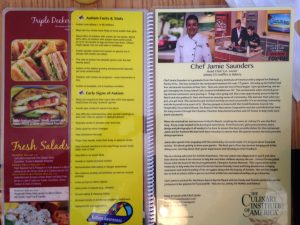
The place advertised the hell out of having a chef who was trained at the Culinary Institute of America, which is in Poughkeepsie, where I used to live. I think CIA needs to monitor who uses its good name in vain like that. It wasn’t terrible, but it was not particularly innovative or anything. I was most impressed with the awareness raising about autism. Apparently the chef’s child has autism, according to our waitress. Waffles with a side of social consciousness? Autism and pancakes? Kinda weird but fitting.
There was also some serious cruising in what I was told are “lifted” cars. Lifted lowriders? I don’t know. I was taking tourist photos of the Starbucks frappacino-mobile for my WTF? file along with others, and they said the cars were “lifted.”
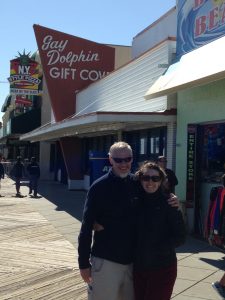
We had best intentions of going to Ripley’s Believe it or Not and playing mini-golf at one of the totally decked out theme places, but walked up and down the boardwalk, went to the Gay Dolphin to shop (shit hole with a bunch of junk, but I got a good magnet about Jesus that says Gay Dolphin, so there’s that), then got tired.
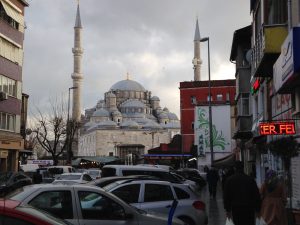
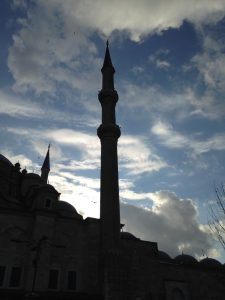
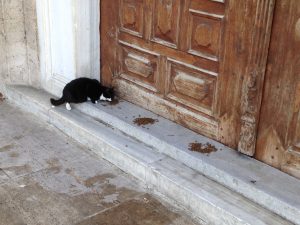
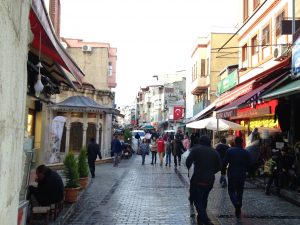
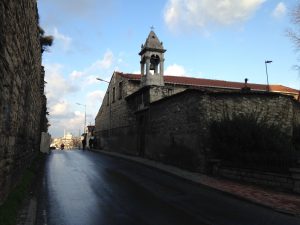
I’m wrapping up a 24 hour layover in Istanbul and on my way to Madagascar now. Turkish Airlines do things right, I have to say. Cramped flight but free movies and good food. They put me up in a hotel in Fatih, which is a historic quarter and came with free breakfast. So after a 10 hour flight to Istanbul, I ate enough to tide me over for 12 hours, slept for 6 hours, walked the streets looking at mosques for 3 hours, took another nap, got a shower, and caught up on messaging family.
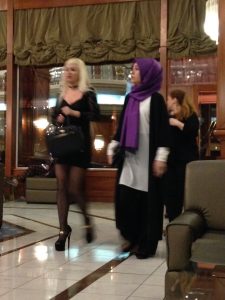
Don’t read too much into this. I simply like this juxtaposition of feminity in the hotel lobby while I waited for the airport shuttle.
“Grand adventure calls and tugs on my heartstrings.”
I didn’t say this, but it’s a good start to this post. It’s what my friend Michaela depicted me as saying to my son Lux as he left the house this morning. I am leaving for a month-long trip that includes a few weeks in Madagascar and was sitting at the window watching his brothers at the bus stop and he was kissing me goodbye.
“Do you watch us get on the bus every day?” he asked me.
I don’t, but I wish I watched them more. I also wish I’d got a photo of them getting on the bus today to alleviate my anxiety and the tugging on my heartstrings. You’d think I’d never traveled or been away from my family before, but for some reason this trip has me more anxious about being away from the kids than usual. The world is a mess, and anxieties are looking for anchorage on things I can’t control (or, in Malinowski-ish, I am leaving the lagoon to fish in the open sea)?
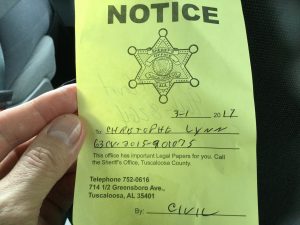
Instead, I got a photo of this, which was on my door after taking Gallifrey for the last walk I’ll be giving him for a month.
Nothing like starting off a month away from home and traveling abroad like a notice from the sheriff about a civil matter. Oh, student loan debt (gulp, I hope?), thank you for that reminder that I still haven’t escaped you, despite feeling like I’m living my anthropological dream.
Before that, however, and after mooning over my children and weirding them out, I slipped back into the perennial dilemma of which of these items that I don’t need could fit in the last remaining crevice of my new suitcase, purchased specifically for this trip since the last one was about to burst and which is now in jeopardy of following its predecessor to rupturing on the luggage carousel.
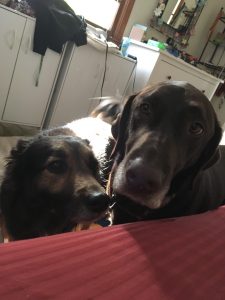
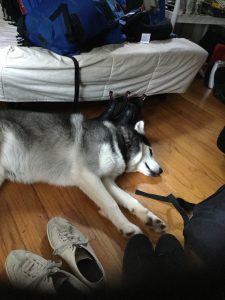
I couldn’t decide which pair of shoes to leave behind, and I needed to find a spot for this giant fuzzy dog pillow. (Note: Using the expand zipper option on your new suitcase to stuff a husky in will put you over the luggage weight limit. You’ll have to pay an extra $100 or remove one husky or two sports coats or pairs of jeans. Damn. However, Gallifrey apparently is on a group text with these friends, who are waiting for me on the other side, courtesy their humans, Michaela Howells, James Loudon, and Carolyn Jost Robinson.)
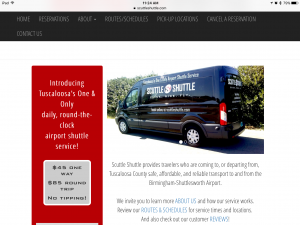
Logistic support is also important. Part of what has me so anxious is lining everything up for my family at home while lining everything up for me for a 2-stage trip. As banal as it is, getting to the airport in Birmingham from Tuscaloosa has been a giant pain in the ass for the entire 7 years we’ve been here until now. We finally have a dependable and affordable shuttle service. Scuttleshuttle.com apparently started last August, but I just found out about them in February when I was juggling pickups for 1700 people for the SEEPS 2017 conference. This is no small thing. They have a good website for booking that is easy to use. Their vans are conveniently located with free park and ride. The vans are nice and new and have free wifi! The drivers are drug and alcohol tested (which I wasn’t really thinking about, but OK) and well paid, so they’re not allowed to accept tips. I chatted up a storm and the time flew by instead of stressing if I was going to have enough time to get the shuttle from the cheap Ramada lot to my plane in time. Booking on the shuttle also forced me onto their schedule, leaving earlier, so I don’t put myself in the position of running late. Of course there is now this 2 hours of sitting in the airport…
So, anyway, DAY ONE: First stop, University of North Carolina Wilmington to get some writing done with Michaela on our “Family and the Field Study,” an invited lecture about tattooing and evolution at UNCW, then off to Madagascar to meet with the director, teachers, and students at Eagles Wings Montessori School and talk about our collaborative program potential.
EvoS Consortium to become subsidiary of This View of Life!
In an effort to optimize forces in our work designed to advance evolution’s place in the modern world, the EvoS Consortium is formally joining forces with – and becoming a subsidiary of – This View of Life (TVOL). TVOL, which is currently engaged in a massive fundraising effort (you can help the cause HERE!), has been a widely successful online initiative, largely designed by David Sloan Wilson, to advance our understanding of the world within an evolution-based framework.
The EvoS Consortium and TVOL have heretofore run as parallel entities. We are excited to announce this intellectual merger which we believe will strongly advance the goals of both entities. Note that a formal letter from David Sloan Wilson and Glenn Geher, demarcating the rationale for this change and the nature of what we can expect, is found here.
We hope that members and followers of EvoS will take advantage of this improvement in our offerings and will continue to work collaboratively as we work to advance an evolutionarily informed understanding of the world and of our place in it.








 I couldn’t decide which pair of shoes to leave behind, and I needed to find a spot for this giant fuzzy dog pillow. (Note: Using the expand zipper option on your new suitcase to stuff a husky in will put you over the luggage weight limit. You’ll have to pay an extra $100 or remove one husky or two sports coats or pairs of jeans. Damn. However, Gallifrey apparently is on a group text with these friends, who are waiting for me on the other side, courtesy their humans, Michaela Howells, James Loudon, and Carolyn Jost Robinson.)